

Project at a Glance#
The short track through S-CORE: how the project is organized, which meetings matter, the key processes and where to find the details.
Who does what#
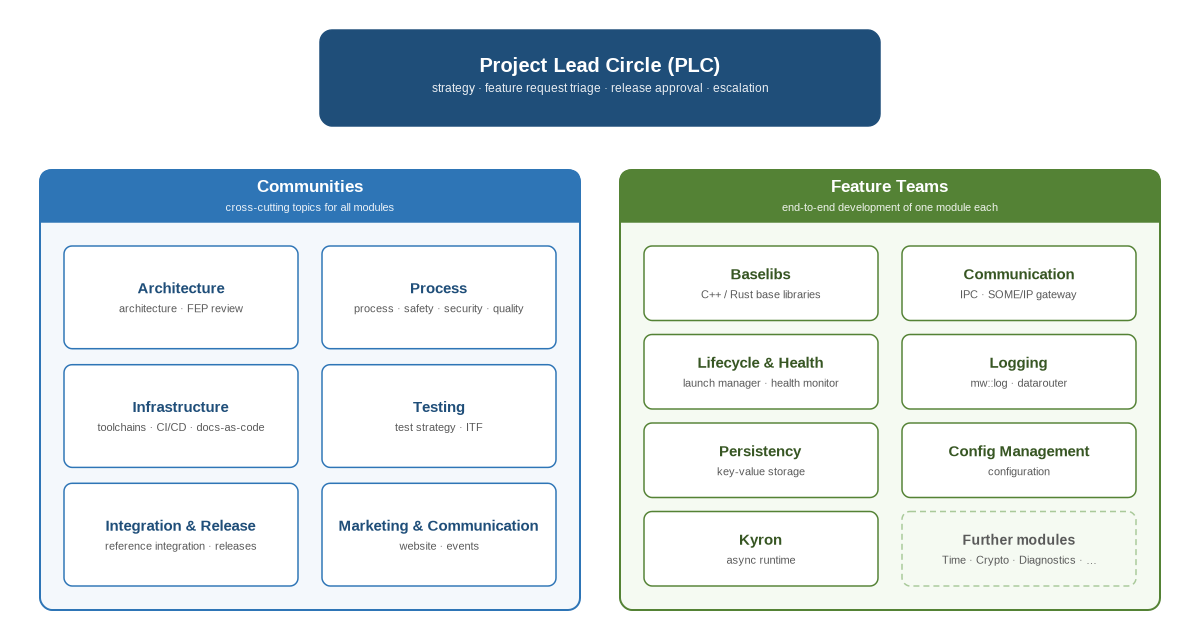
Body |
Responsibility |
|---|---|
Project Lead Circle (PLC) |
Strategic and technical decisions, triage of feature requests, adding/removing repositories, release planning and approval, escalation |
Communities |
Topics that span all modules; each has a Community Lead and a deputy |
Feature Teams |
One module each, from architecture to integration test; each has a Lead and at least one Committer |
The bodies, their members and owned repositories are described in Project Organization.
Most important meetings#
All meetings are open to everyone; dates and times are in the S-CORE calendar. The most important ones (Project Lead Circle, Leads Alignment, Community and Feature Team meetings), what happens there and the links to their general information and minutes are listed in Meetings.
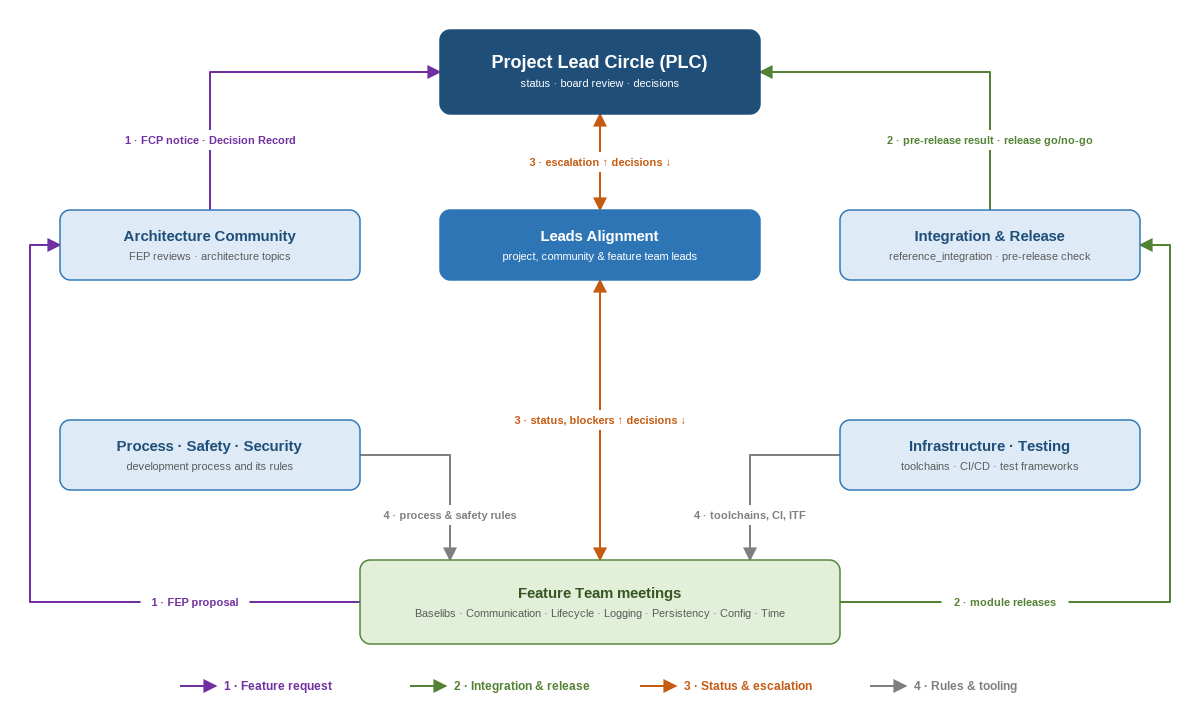
The diagram shows the main processes between the meetings, explained in How the meetings work together.
Most important concepts#
Common#
Decisions go up, work goes sideways: the PLC decides; Communities set common rules; Feature Teams build the modules.
Teams are created or closed by the PLC (see Project Management Plan).
Everything is open: all meetings are in the S-CORE calendar and open to everyone; minutes are public in the GitHub Discussions.
Members and leads are defined by the CODEOWNERS of the owned repositories.
Feature Request (FEP)#
New features and changes with impact on the platform or other teams go through the Feature & Enhancement Proposal (FEP) track: the proposal is reviewed by the Architecture Community and decided after a Final Comment Period; changes inside one team use the normal Issue/PR flow. The process is described in the FEP guideline.
As defined in the Project Management Plan, the PLC triages incoming requests and is notified once a FEP enters its Final Comment Period.
Decision Record (DR)#
Every relevant decision is a Decision Record (
dec_recneed) in Decision Records, created by PR.Grouped by category: strategy, architecture, infrastructure, process, integration, AI (e.g.
DR-003-Stratmodule maturity levels).Status:
proposed→accepted; a DR keeps the original decision and rationale, guidelines built on it may evolve separately.Accepted FEPs become DRs; a team may also write a DR for its own decisions to persist the rationale.
Integration & Release process#
Releases are milestones in the score repository, planned and approved by the PLC.
Modules release independently (strict SemVer) into the S-CORE Bazel registry. SemVer applies to the public API and features: only a backward-incompatible change (breaking API change, removed or incompatibly changed feature) means a new MAJOR version; compatible enhancements are MINOR, fixes PATCH.
Reference Integration pins every module in known_good.json (release or exact commit), builds them together and runs tests, showcases and images on all target platforms (see Integration process).
Weekly pre-release check: problems between module releases are found early, see Weekly Pre-Release Check.
Release: release candidate branch → release note with module versions and maturity per module (Release / Experimental / Preview, DR-003 (dec_rec__strat__module_maturity_levels)).
Module Maturity#
Every module in a platform release carries exactly one maturity level (Module Maturity Classification (dec_rec__strat__module_maturity_levels)). This lets all modules be part of the release while telling users how far each one is.
Level |
Process artifacts |
Requirements |
Quality statement |
|---|---|---|---|
Preview |
none or incomplete |
undetermined |
not possible |
Experimental |
complete |
not all implemented / tested, gaps are transparent |
yes, with known gaps |
Release |
complete, only minor deviations |
all implemented and fully tested |
yes |
Artifacts first: without the process artifacts (verification report, traceability, inspection checklists) no quality statement is possible, so the module stays Preview.
Declared by the module: each module sets
:maturity: preview | experimental | releaseon itsmodneed in its own docs (docs-as-code); the release note shows it per module.Not yet defined: exact border between minor and major deviations, who approves a level, and downgrades when the process changes.
Most important links#
All links to organization, meetings, contribution, decisions, integration & release, repositories and tooling are collected in Useful Links.