DR-008-Int: S-CORE integration scope in reference_integration repository#
Date: 2026-06-11
Integration scope in reference_integration repository
|
status: accepted
|
||||
Context / Problem#
Currently there is no clear definition of scope and responsibilities of the reference_integration repository.
The process of integration of S-CORE modules is time consuming and leaves open space for misalignment
between the process and the feature teams.
Goals and Requirements#
Effort: The integration process should be as efficient as possible with clear feedback loops.
Independence: Modules should be independent with their implementation scope.
Integration: Modules should have clear common requirements for S-CORE release integration.
Clear Ownership: Each module should have a clear vision of responsibilities for integrating into reference_integration.
Maintainability: Keep long-term maintenance effort low.
Non-Goals#
Controlling every release of each Module - Modules can release independently and some releases can be not integrated into S-CORE.
Options Considered#
Option 1: Execute only Feature Integration Tests in reference_integration repository#
Reference_integration repository is a place where only Feature Integration Tests are executed. Every Module is responsible for executing static tests, UTs, CITs in their respective repositories, used configurations, compiling flags and workflows should be aligned with S-CORE guidelines.
Reference_integration will provide a means to conduct continuous integration, based on only Feature Integration Tests, of latest Modules states to ensure early feedback and breaking changes notifications.
For S-CORE releases, Modules need to deliver artifacts from local tests as their release assets to be used for certification and documentation.
Pros:
Modules have full control over their own scope
Quick integration jobs in reference_integration repository as only Feature Integration tests are executed
Cons:
No control over configuration, compiling flags, variants
Documentation and artifacts are distributed across different repositories
Full-stack S-CORE release might resolve to different version of dependencies that were tested in Module repositories which makes the release not compliant with S-CORE release requirements.
Option 2: Re-execute all quality checks in the reference_integration repository#
Reference_integration repository is a place where all kinds of tests - static, UTs, CITs, FITs are re-executed for full verification of the S-CORE full-stack. Every Module needs to ensure their tests are executable in reference_integration repository. For the verification process, common configuration, compiling flags are used across all Modules to ensure the compliance with current S-CORE guidelines.
Reference_integration will provide a means to conduct continuous integration of latest Modules states to ensure early feedback and breaking changes notifications.
All necessary artifacts and single documentation build are generated in reference_integration repository to be used for certification and documentation of S-CORE releases.
Pros:
Single point of truth for configurations, compiling flags, documentation and certification artifacts
Better control over resolved dependencies
Better traceability of the tests and documentation for full-stack S-CORE releases
Cons:
Additional effort for the Module teams to maintain their tests and dependencies to be fully executable in reference_integration repository
Longer integration jobs in reference_integration repository as all tests are executed
Option 3: Front-load quality checks in modules with lightweight reference_integration#
Modules follow the S-CORE process and run quality tooling in their own context against their own resolved dependency set. Across modules, teams agree on what quality tooling and toolchains to use, but each module runs them independently. Most importantly, teams agree on dependency versions for the upcoming S-CORE release: if a module is releasing a new version into the next S-CORE release, every module that depends on it must migrate to that version before the release. Modules minimize non-dev, non-S-CORE dependencies in their MODULE.bazel files.
Module Owners deliver as part of their release artifacts in the common form allowing aggregation and full documentation build in reference_integration. Bazel dependency analysis will allow verification that collected artifacts are valid for S-CORE release - resolved dependencies for the Module (in scope of their repository) must match the dependencies for S-CORE release and resolved in reference_integration.
Continous integration of latest Modules based on hashes from their main branches will not allow verification of the artifacts and full documentation build. That will remain exclusive for S-CORE releases.
Module-side activities required for an S-CORE release integration:
Automated quality checks (static analysis, unit tests, CITs) using the tooling and versions agreed centrally and tracked in the S-CORE tools evaluation list — see score_tools_evaluation_list (single source of truth for tool versions, classification, and qualification reports).
Manual quality checks per the S-CORE quality workflow, including process conformance checks, work-product reviews, and the QMS report.
Resolution of all static-analysis findings and security vulnerabilities reported in the Eclipse S-CORE security overview — open findings block integration into the S-CORE release.
Module Release Notes produced from the S-CORE module release-note template and verified per the module release-note workflow.
reference_integration activities required for an S-CORE release:
Feature Integration Tests (FITs).
Bazel-graph based consistency and dependency-resolution checks.
Consolidation of module safety artifacts (test results, coverage, analysis reports).
Full documentation build (release builds only).
Generation and verification of the Platform Release Notes (derived where possible from the module release notes), the Platform Handbook, and the Platform Verification Report.
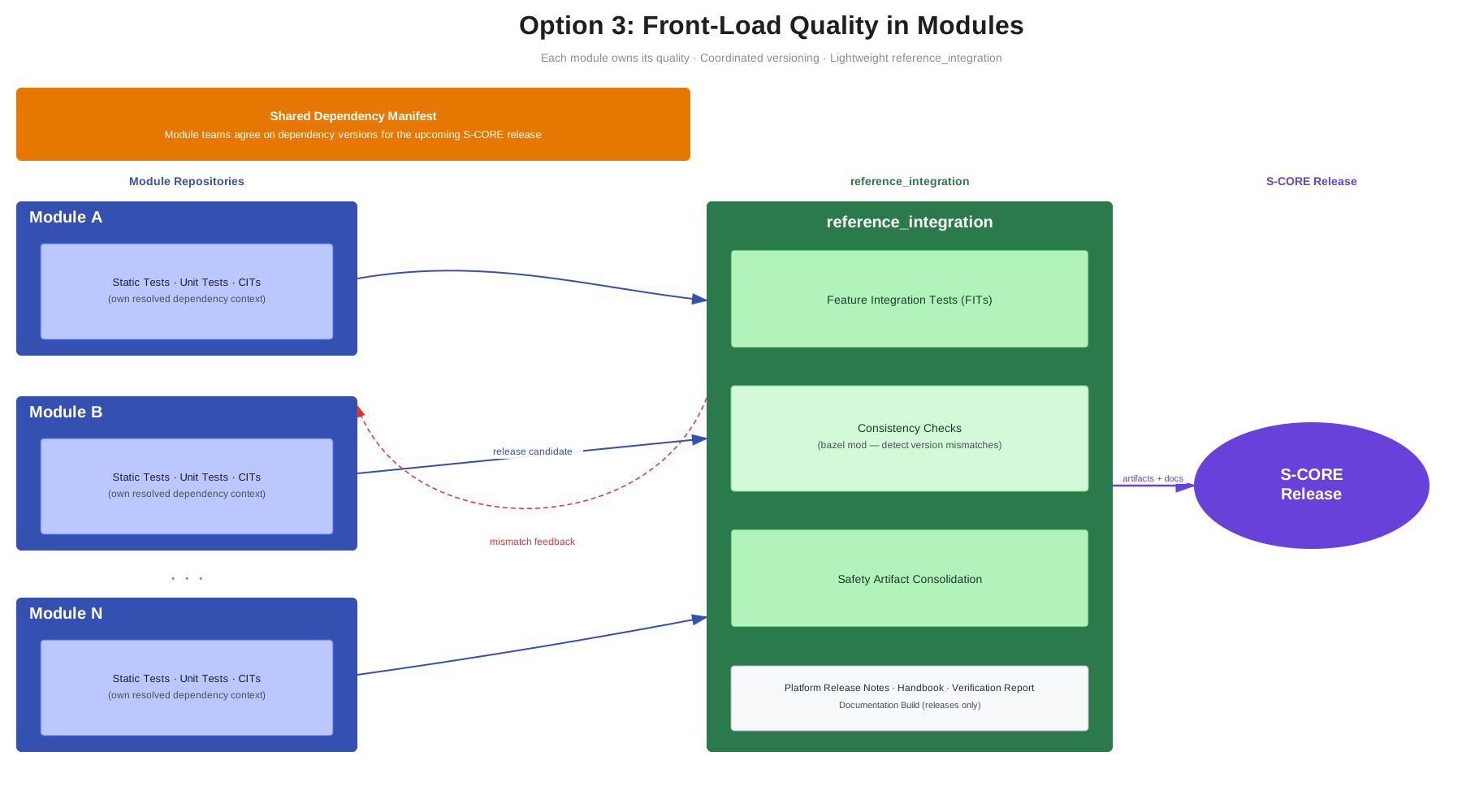
Fig. 38 Option 3 visual breakdown#
Pros:
Verifying quality where it originates is more reliable — modules have full knowledge of their domain, their specific quality requirements, and the exact dependency context they were tested against
Technically simpler reference_integration with a well-defined, minimal scope
Avoids re-executing all checks in a different dependency context, which can mask or introduce issues
Provides early feedback through regular release candidate publishing
Cons:
Requires tighter communication and coordination across module teams
Agreeing on and enforcing a shared dependency manifest adds process overhead
Backward compatibility guarantees need to be actively maintained across all modules
Option 4: Stable known good with module-scoped validation#
Reference_integration repository maintains a stable known good, a pinned set of Module versions that are verified to work together. When a new Module release candidate, third-party dependency, dev tool version, or toolchain update appears, a new candidate is created by updating the known good set and running a two-stage validation pipeline.
In the first stage, reference_integration performs integration-scoped checks on the full stack. This includes building the integrated platform for supported targets, running Platform Integration Tests and Feature Integration Tests, and retrieving the resolved dependency set, including transitive dependencies. In the second stage, each Module is validated in its own repository context, but against the dependency versions resolved by reference_integration. Temporary override mechanisms, such as injected lock data or MODULE.bazel patching, can be used during the pipeline run without changing the released Module sources. Stage 2 runs a minimal baseline of component and unit tests, which can be extended with additional checks where a Module needs broader validation.
This keeps quality checks close to the owning Module while still validating the exact dependency set selected by the full-stack integration. Failures can optionally be delegated into automatically created pull requests in the affected Module repositories, allowing the normal Module CI to provide diagnostics. Quality reports are consolidated from both the integration-scoped and Module-scoped stages.
To support this flow, Modules keep their public dependency footprint minimal and continue to use quality tooling as development dependencies where appropriate. Modules additionally provide a small integration or acceptance test set that proves black-box usability when consumed as a dependency.
Pros:
Validates the dependency set actually resolved by the full-stack while keeping Module tests in their natural repository context
Provides a short feedback loop through stable known good promotion and frequent candidate updates
Avoids promoting quality tooling dependencies into the released dependency footprint of each Module
Makes failures easier to diagnose by keeping ownership and CI execution close to the responsible Module
Cons:
Requires additional orchestration to inject resolved dependency versions into Module-scoped validation runs
Consolidation of documentation and some release artifacts remains more complex than in a fully centralized setup
Temporary validation state must be governed carefully so release evidence stays consistent and auditable
Comparison#
Criterion |
Option 1 |
Option 2 |
Option 3 |
Option 4 |
|---|---|---|---|---|
Quality checks location |
Module repositories only |
reference_integration (re-executed) |
Module repositories (front-loaded) |
Split between reference_integration and Module repositories |
Feature integration tests |
reference_integration |
reference_integration |
reference_integration |
reference_integration |
Dependency mismatch risk |
High |
Low |
Low (via version agreements) |
Low (validated against resolved full-stack set) |
Integration job duration |
Short |
Long |
Short |
Medium |
Artifact & documentation consolidation |
Distributed across repositories |
Single point of truth |
Consolidated at release time |
Consolidated reports, documentation still more involved |
Module team maintenance effort |
Low |
High |
Medium |
Medium |
Cross-module coordination overhead |
Low |
Medium (triage of CI failures) |
Medium (shared dependency manifest) |
Medium (stable known good rollout) |
Traceability for S-CORE release |
Weak |
Strong |
Strong (via release artifacts) |
Strong (via combined integration and Module evidence) |
Evaluation#
Option 1 makes S-CORE provide a set of SEooCs without being a full-stack project that has been selected in Consistent Stack vs. Refere... (dec_rec__strat__consistent_stack_vs_reference). Modules are responsible for their own compliance with the S-CORE release requirements, which makes it difficult to validate the final S-CORE release for the process compliance. The biggest risk is that Module A can deliver a release and artifacts with dependency on Module B in version x.y.z, but in reference_integration thus overall S-CORE release, Module B will be resolved in version x.y.z+1, which makes Module A artifacts not compliant.
Option 2 truly makes S-CORE a full-stack project and provides a single point of truth for the configurations, compiling flags, variants, documentation and certification artifacts. However, it requires additional effort for the module teams to maintain their tests and dependencies to be fully executable in the reference_integration repository with both public APIs and tests. It allows generating a single documentation build with full traceability across different repositories which will stay persistent and will not require external linking.
Option 3 front-loads quality verification into the modules themselves and keeps reference_integration lightweight. It addresses the dependency mismatch risk of Option 1 through coordinated version agreements across modules rather than by re-executing checks centrally. However, it relies on disciplined inter-module coordination and backward compatibility guarantees, which adds process overhead and requires a shared dependency manifest to remain manageable.
Option 4 combines the full-stack validation goal of Option 2 with the local ownership model of Option 3. The stable known good concept keeps reference_integration focused on validating concrete integration candidates, while the Module-scoped second stage ensures that component and unit tests run in the Module’s own environment but against the exact dependency set selected by the integrated stack. This addresses the main dependency mismatch concern without forcing all quality tooling into the public dependency footprint of every Module.
Compared with Option 2, Option 4 reduces the risk of building an overly centralized integration setup that is harder for Module teams and downstream users to reproduce. Compared with Option 3, it improves feedback on dependency and compatibility issues by testing against a pinned, evolving full-stack baseline rather than relying only on version agreements. The remaining cost is additional pipeline orchestration and a need to define how documentation and release evidence are consolidated when Module validation runs with temporary dependency overrides.
Decision: Option 4 got positive feedback and was selected by the community. We accept the additional orchestration needed to validate Modules against the dependency set resolved by reference_integration, in exchange for shorter feedback loops, stronger confidence in the stable known good baseline, and quality checks that remain close to the owning Module context.