Red Hat AutoSD#
AutoSD is the upstream binary distribution that serves as the public, in-development preview and functional precursor of the Red Hat In-Vehicle Operating System (OS).
AutoSD is downstream of CentOS Stream, so it retains most of the CentOS Stream code with a few divergences, such as an optimized automotive-specific kernel rather than CentOS Stream’s kernel package.
Red Hat In-Vehicle OS is based on both AutoSD and RHEL, both of which are downstreams of CentOS Stream.
Target Maintainers/Integration Assistance#
GitHub Handles of the target maintainers.
Leonardo Rossetti - @odra
Integration Assistance#
The following fulfills integration assistance (aou_req__platform__integration_assistance)
Leonardo Rossetti |
|
Github Handler |
@odra |
Slack Handler |
@lrossett |
Integration Manual#
The following fulfills integration manual (aou_req__platform__os_integration_manual)
Build Instructions#
Building an AutoSD image can be done by using “aib”: CentOS/automotive/src/automotive-image-builder
Sample usage:
export OCI_IMAGE=localhost/score:latest
export AIB_DISTRO=autosd10-sig

aib build-builder --distro ${AIB_DISTRO}
aib build --target qemu --distro ${AIB_DISTRO} image.aib.yml ${OCI_IMAGE}
aib to-disk-image ${OCI_IMAGE} autosd-score.qcow2
As an alternative, you can replace the bare metal “aib” usage with a bash script that runs the tool inside an OCI container:
curl -o auto-image-builder.sh "https://gitlab.com/CentOS/automotive/src/automotive-image-builder/-/raw/main/auto-image-builder.sh"
chmod +x auto-image-builder.sh
You can then replace the usage of “aib” with “auto-image-builder.sh” (requires sudo):
export OCI_IMAGE=localhost/score:latest
export AIB_DISTRO=autosd10-sig
# set the container storage to the local "_builder" directory to avoid permissions issues
export AIB_LOCAL_CONTAINER_STORAGE=$PWD/_build/containers-storage

sudo -E ./auto-image-builder.sh build-builder --distro ${AIB_DISTRO}
sudo -E ./auto-image-builder.sh build --target qemu --distro ${AIB_DISTRO} image.aib.yml ${OCI_IMAGE}
sudo -E ./auto-image-builder.sh to-disk-image ${OCI_IMAGE} autosd-score.qcow2
If using QEMU, you can run the image using the following command:
/usr/bin/qemu-system-x86_64 \
-drive file=/usr/share/OVMF/OVMF_CODE_4M.fd,if=pflash,format=raw,unit=0,readonly=on \
-drive file=/usr/share/OVMF/OVMF_VARS_4M.fd,if=pflash,format=raw,unit=1,snapshot=on,readonly=off \
-enable-kvm \
-m 2G \
-smp $(nproc) \
-machine q35 \
-cpu host \
-device virtio-net-pci,netdev=n0 \
-netdev user,id=n0,hostfwd=tcp::2222-:22 \
-daemonize \
-display none \
-drive file=disk.qcow2,index=0,media=disk,format=qcow2,if=virtio,id=rootdisk,snapshot=off
Toolchain#
Upstream documentation: eclipse-score/inc_os_autosd
A Bazel toolchain defintion is provided for users to build their Bazel modules and components with AutoSD’s tooling (compilers, libraries, etc).
Sample usage (MODULE.bazel file):
# Use local path during development, or git_override for published versions
local_path_override(
    module_name = "os_autosd",
    path = "/path/to/inc_os_autosd/"
)

bazel_dep(name = "os_autosd", version = "1.0.0")

# Configure AutoSD 9 GCC toolchain
autosd_10_gcc = use_extension("@os_autosd//toolchain/autosd_10_gcc:extensions.bzl", "autosd_10_gcc_extension")
autosd_10_gcc.configure(
    c_flags = ["-Wall", "-Wno-error=deprecated-declarations", "-Werror", "-fPIC"],
    cxx_flags = ["-Wall", "-Wno-error=deprecated-declarations", "-Werror", "-fPIC"],
)

use_repo(autosd_10_gcc, "autosd_10_gcc_repo")
register_toolchains("@autosd_10_gcc_repo//:gcc_toolchain_linux_x86_64")
NOTE: AutoSD’s tooling does not support cross compilation.
Mixed Critical Orchestration#
Upstream documentation: https://sigs.centos.org/automotive/features-and-concepts/con_mixed-criticality/
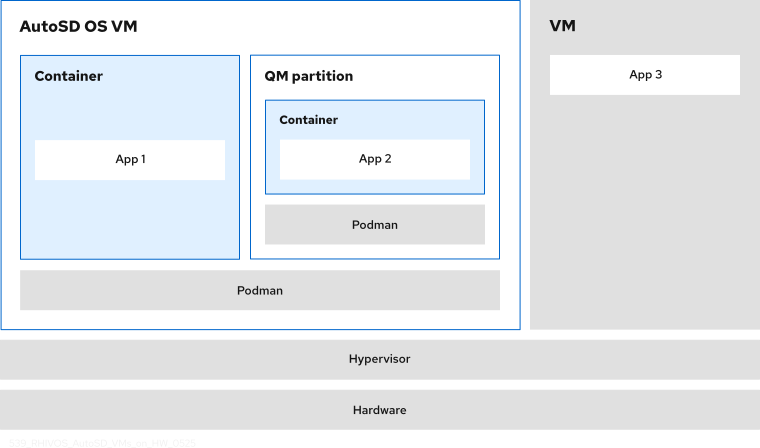
Mixed Critical Orchestration, aka MCO, can be achieved with the following components:
Systemd: the init system that is responsible for workload orchestration
Eclise BlueChi: extends Systemd to enable multi-node and multi domain orchestration
QM: Quality management environment that is composed of two sub-systems: a dedicated rootfs partition + container isolation
ASIL and QM connectivity is done either via an IPC socket or shared memory (/dev/shm).
Bug Interface#
The following fulfills bug interface (aou_req__platform__bug_interface)
CentOS SIG Automotive Mailing List |
https://lists.centos.org/hyperkitty/list/automotive-sig@lists.centos.org/ |
Gitlab Issue Tracker |
|
CentOS SIG Matrix Channel |
https://app.element.io/#/room/#centos-automotive-sig:fedoraproject.org |
Eclipse SDV Slack Channel |
#autosd (https://sdvworkinggroup.slack.com/archives/C0986LJ9EJH) |