TA-ANALYSIS | Reviewed: ⨯ | Score: 0.0#
Collected data from tests and monitoring of deployed software in eclipse-score/inc_nlohmann_json is analysed according to specified objectives.
Supported Requests:
Item |
Summary |
Score |
Status |
|---|---|---|---|
Evidence is provided within eclipse-score/inc_nlohmann_json to demonstrate that the nlohmann/json library does what it is supposed to do, and does not do what it must not do. |
0.00 |
⨯ Item Reviewed |
Supporting Items:
Item |
Summary |
Score |
Status |
|---|---|---|---|
Failure rates of CI tests are analysed for both the upstream nlohmann/json and the eclipse-score/inc_nlohmann_json repositories, and any high failure rates are reasonably justified. |
0.00 |
⨯ Item Reviewed |
|
Any failed CI pipeline executions in the master branch of the nlohmann/json repository are analyzed and fixed. |
0.00 |
⨯ Item Reviewed |
References:
None
Fallacies:
None
Graph:
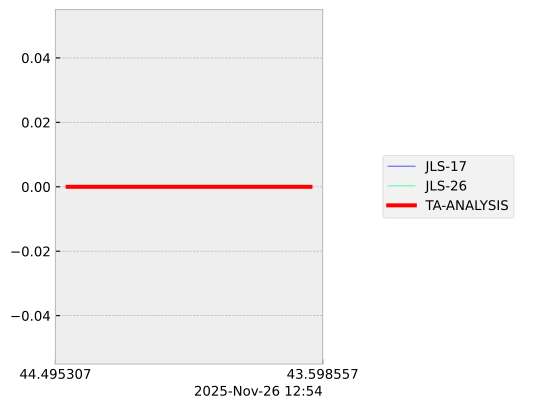
date-time |
TA-ANALYSIS |
JLS-17 |
JLS-26 |
|---|---|---|---|
2025-11-26 12:04:09 |
0.00 |
0.00 |
0.00 |
2025-12-10 14:14:18 |
0.00 |
0.00 |
0.00 |
2025-12-16 13:14:25 |
0.00 |
0.00 |
0.00 |
2026-01-12 14:03:00 |
0.00 |
0.00 |
0.00 |
2026-01-15 09:03:37 |
0.00 |
0.00 |
0.00 |
2026-01-15 09:53:53.821650 |
0.00 |
0.00 |
0.00 |
(Note: The guidance, evidence, confidence scoring and checklist sections below are copied from CodeThink’s documentation of TSF. However, the answers to each point in the evidence list and checklist are specific to this project.)
Guidance
This assertion is satisfied to the extent that test data, and data collected from monitoring of deployed versions of nlohmann/json, has been analysed, and the results used to inform the refinement of Expectations and risk analysis.
The extent of the analysis is with sufficient precision to confirm that:
all Expectations (TA-BEHAVIOURS) are met
all Misbehaviours (TA-MISBEHAVIOURS) are detected or mitigated
all advance warning indicators (TA-INDICATORS) are monitored
failure rates (calculated directly or inferred by statistics) are within acceptable tolerance
When tests reveal Misbehaviours missing from our analysis (TA-ANALYSIS), we update our Expectations (TA-BEHAVIOURS, TA-MISBEHAVIOURS). Guided by confidence evaluations (TA-CONFIDENCE), we refine and repeat the analysis as needed. Analysis results also inform confidence evaluations, allowing automatic generation through statistical modelling and defining Key Performance Indicators (KPIs) for consistent use across the TSF.
For increased confidence in the analysis specification and results, they should be evaluated in terms of their reliability, relevance, and understandability.
Reliability: The analysis methods must be verified against both known good and bad data to ensure sufficient detection of false negatives and false positives. Accuracy degradation across methods should be tracked and aggregated, making outcomes more easily verifiable and providing visibility into how changes to the system under test or to the analysis mechanisms affect the results.
Relevance: The results must account for hardware and hardware/software interactions. Calibration should address capacity, scalability, response time, latency, and throughput where applicable. To further increase confidence in estimated failure rates, the analysis should also cover testing sufficiency (with statistical methods where appropriate), cascading failures including sequencing and concurrency, bug analysis, and comparison against expected results and variability. The analysis should be automated and exercised repeatedly for timely feedback.
Understandability: Both methods and results should be mapped to other analyses performed on the system (linked to TT_EXPECTATIONS) to ensure alignment with scope, abstraction levels, and partitioning, thereby guiding prioritisation. Effectiveness also depends on user-friendliness and presentation (involving semi-formal structured forms, supported by diagrams and figures with clear legends).
To gain increased confidence, test results should be shown to be reproducible. Even with non-deterministic software, representative test setups must be ensured to produced reproducible results within a defined threshold as specified by TT-EXPECTATIONS. Reproducible test results also supports verification of toolchain updates (together with other measures in TA-FIXES), by confirming that test results remain unchanged when no changes are intended.
Evidence
Analysis of test data, including thresholds in relation to appropriate statistical properties.
Answer: The analysis of test data is captured by JLS-17, but no explicit quantitative thresholds are defined.
Analysis of failures
Answer: Provided by JLS-26 and JLS-17.
Analysis of spikes and trends
Answer: CI test failure rates for the upstream
nlohmann/jsonrepository andeclipse-score/inc_nlohmann_jsonare analysed using the time-series based GitHub Actions metrics views. This analysis is performed manually (see JLS-17). There is currently no fully automated, continuous analysis of failures.
Validation of analysis methods used
Answer: There is no separate formal validation of the analysis methods.
Confidence scoring
Confidence scoring for TA-ANALYSIS is based on KPIs that may indicate problems in development, test, or production.
CHECKLIST
What fraction of Expectations are covered by the test data?
Answer: The two expectations are JLEX-01 and JLEX-02. Every statement supporting either of these expectations is ultimately supported by a test, except for WFJ-06. WFJ-06 specifies that
basic_json::acceptmust accept exactly JSON values for all possible inputs. Since there are infinitely many possible inputs, this cannot be tested exhaustively. Indirect tests are provided by the rejection of ill-formed json data.
What fraction of Misbehaviours are covered by the monitored indicator data?
Answer: Currently none, because there is no implemented monitoring of deployed instances yet. This is a future integrator responsibility (see AOU-09, AOU-18 and AOU-19).
How confident are we that the indicator data are accurate and timely?
Answer: No indicator data is collected (see the previous question).
How reliable is the monitoring process?
Answer: See the previous question.
How well does the production data correlate with our test data?
Answer: There are no production data.
Are we publishing our data analysis?
Answer: Analyses of CI tests failure rates are published in the TSF documentation on GitHub (via ci_failure_rate_analysis.md), but there is currently no published analysis of production monitoring data.
Are we comparing and analysing production data vs test?
Answer: There is no production data.
Are our results getting better, or worse?
Answer: There are no explicit quantitative trends that indicate whether results are improving or degrading over time.
Are we addressing spikes/regressions?
Answer: There is currently no monitored indicator data, so spikes in indicator trends are not tracked. However, any failing tests in CI are investigated and fixed, and fuzz-testing results in the original nlohmann/json repository are analysed and addressed.
Do we have sensible/appropriate target failure rates?
Answer: No explicit numeric failure-rate targets are defined. The implicit target is that the CI test suite passes and known misbehaviours remain within an acceptable, manually monitored range.
Do we need to check the targets?
Answer: For unit and integration tests, there are no explicit failure rate targets. The implicit target is that the CI test suite passes on all supported environments, which is continuously checked by the CI workflows (see JLS-26). Since the fuzz testing runs and is investigated in the original nlohmann/json repository, there is no need to check the target.
Are we achieving the targets?
Answer: For the unit and integration tests, yes. The degree of target achievement for the fuzz-testing is evaluated within the original nlohmann/json repository.
Are all underlying assumptions and target conditions for the analysis specified?
Answer: For all tests, the underlying assumption and target condition is that they should cover all expectations, and that no test is expected to fail. Any failed tests are analyzed and reasonably justified or fixed.
Have the underlying assumptions been verified using known good data?
Answer: The input data from nlohmann/json_test_data which is used for the tests contain both known good data and known bad data. As each expectation is mapped to a sub-set of tests, it is indeed verified that the underlying assumption is reasonably verified.
Has the Misbehaviour identification process been verified using known bad data?
Answer: Yes. The misbehaviour identification process has been exercised using known bad data from nlohmann/json_test_data
Are results shown to be reproducible?
Answer: A dedicated ci_reproducible_tests target exists to run a reproducible subset of tests, but not all tests are fully reproducible (see JLS-62).
TA-BEHAVIOURS | Reviewed: ⨯ | Score: 0.0#
Expected or required behaviours for the nlohmann/json library are identified, specified, verified and validated based on analysis.
Supported Requests:
Item |
Summary |
Score |
Status |
|---|---|---|---|
Documentation is provided within eclipse-score/inc_nlohmann_json, specifying what the nlohmann/json library is expected to do, and what it must not do, and how this is verified. |
0.00 |
⨯ Item Reviewed |
Supporting Items:
Item |
Summary |
Score |
Status |
|---|---|---|---|
The requirement regarding JSON Validation is fulfilled. |
0.00 |
⨯ Item Reviewed |
|
The requirement regarding JSON Deserialization is fulfilled. |
0.00 |
⨯ Item Reviewed |
|
Automated tests within the TSF documentation are reviewed by a Subject Matter Expert to verify they test the properties they claim to. |
0.00 |
⨯ Item Reviewed |
|
The test coverage for this version of nlohmann/json is monitored using Coveralls and is not decreasing over time, unless reasonably justified. |
0.00 |
⨯ Item Reviewed |
References:
None
Fallacies:
None
Graph:
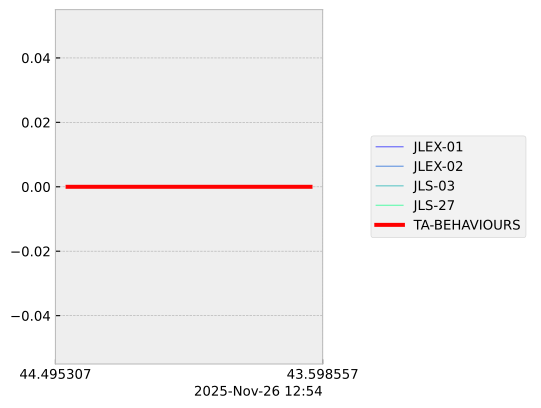
date-time |
TA-BEHAVIOURS |
JLEX-01 |
JLEX-02 |
JLS-03 |
JLS-27 |
|---|---|---|---|---|---|
2025-11-26 12:04:09 |
0.00 |
0.00 |
0.00 |
0.00 |
0.00 |
2025-12-10 14:14:18 |
0.00 |
0.00 |
0.00 |
0.00 |
0.00 |
2025-12-16 13:14:25 |
0.00 |
0.00 |
0.00 |
0.00 |
0.00 |
2026-01-12 14:03:00 |
0.00 |
0.00 |
0.00 |
0.00 |
0.00 |
2026-01-15 09:03:37 |
0.00 |
0.00 |
0.00 |
0.00 |
0.00 |
2026-01-15 09:53:53.821650 |
0.00 |
0.00 |
0.00 |
0.00 |
0.00 |
(Note: The guidance, evidence, confidence scoring and checklist sections below are copied from CodeThink’s documentation of TSF. However, the answers to each point in the evidence list and checklist are specific to this project.)
Although it is practically impossible to specify all of the necessary behaviours and required properties for complex software, we must clearly specify the most important of these (e.g. where harm could result if given criteria are not met), and verify that these are correctly provided by nlohmann/json.
Guidance
This assertion is satisfied to the extent that we have:
Determined which Behaviours are critical for consumers of nlohmann/json and recorded them as Expectations.
Verified these Behaviours are achieved.
Expectations could be verified by:
Functional testing for the system.
Functional soak testing for the system.
Specifying architecture and verifying its implementation with pre-merge integration testing for components.
Specifying components and verifying their implementation using pre-merge unit testing.
The number and combination of the above verification strategies will depend on the scale of the project. For example, unit testing is more suitable for the development of a small library than an OS. Similarly, the verification strategy must align with the chosen development methods and be supported by appropriate verification approaches and tools.
Regardless of the chosen strategy, the reasoning behind it must be recorded in a traceable way, linking breakdown and verification methods to the relevant reasoning, abstraction levels, and design partitioning (including system interfaces with users and hardware, or other system boundaries).
Finally, the resulting system must be validated, with the foundation of validation being a working system that has appropriately considered calibration targets such as capacity, scalability, response time, latency, and throughput, where applicable. Without this, specification and verification efforts cannot be considered sufficient.
Evidence
List of Expectations
Answer:
Argument of sufficiency for break-down of expected behaviour for all Expectations
Answer:
Validation and verification of expected behaviour
Answer:
Confidence scoring
Confidence scoring for TA-BEHAVIOURS is based on our confidence that the list of Expectations is accurate and complete, that Expectations are verified by tests, and that the resulting system and tests are validated by appropriate strategies.
Checklist
How has the list of Expectations varied over time?
Answer:
How confident can we be that this list is comprehensive?
Answer:
Could some participants have incentives to manipulate information?
Answer:
Could there be whole categories of Expectations still undiscovered?
Answer:
Can we identify Expectations that have been understood but not specified?
Answer:
Can we identify some new Expectations, right now?
Answer:
How confident can we be that this list covers all critical requirements?
Answer:
How comprehensive is the list of tests?
Answer:
Is every Expectation covered by at least one implemented test?
Answer:
Are there any Expectations where we believe more coverage would help?
Answer:
How do dependencies affect Expectations, and are their properties verifiable?
Answer:
Are input analysis findings from components, tools, and data considered in relation to Expectations?
Answer:
TA-CONFIDENCE | Reviewed: ⨯ | Score: 0.0#
Confidence in the nlohmann/json library is measured based on results of analysis.
Supported Requests:
Item |
Summary |
Score |
Status |
|---|---|---|---|
Confidence in the nlohmann/json library is achieved by measuring and analysing behaviour and evidence over time within eclipse-score/inc_nlohmann_json. |
0.00 |
⨯ Item Reviewed |
Supporting Items:
Item |
Summary |
Score |
Status |
|---|---|---|---|
Each leaf node in the Trustable Graph that is not an Assumption-of-Use (AoU) is scored either based on SME review(s) alone or on a combination of SME review(s) and an automatic validator. |
0.00 |
⨯ Item Reviewed |
|
Scores within the TSF documentation are reasonably, systematically and repeatably accumulated. |
0.00 |
⨯ Item Reviewed |
|
A github workflow of eclipse-score/inc_nlohmann_json saves the history of scores in the trustable graph to derive trends. |
0.00 |
⨯ Item Reviewed |
|
High-level statements are decomposed into smaller, recursive statements. |
0.00 |
⨯ Item Reviewed |
References:
None
Fallacies:
None
Graph:
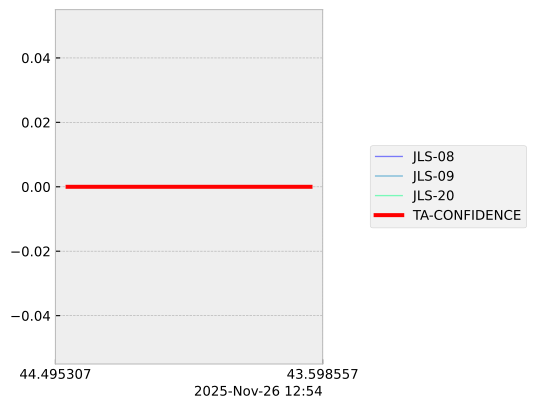
date-time |
TA-CONFIDENCE |
JLS-08 |
JLS-09 |
JLS-20 |
JLS-37 |
|---|---|---|---|---|---|
2025-11-26 12:04:09 |
0.00 |
0.00 |
0.00 |
0.00 |
N/A |
2025-12-10 14:14:18 |
0.00 |
0.00 |
0.00 |
0.00 |
N/A |
2025-12-16 13:14:25 |
0.00 |
0.00 |
0.00 |
0.00 |
0.00 |
2026-01-12 14:03:00 |
0.00 |
0.00 |
0.00 |
0.00 |
0.00 |
2026-01-15 09:03:37 |
0.00 |
0.00 |
0.00 |
0.00 |
0.00 |
2026-01-15 09:53:53.821650 |
0.00 |
0.00 |
0.00 |
0.00 |
0.00 |
(Note: The guidance, evidence, confidence scoring and checklist sections below are copied from CodeThink’s documentation of TSF. However, the answers to each point in the evidence list and checklist are specific to this project.)
Guidance
To quantify confidence, either a subjective assessment or a statistical argument must be presented for each statement and then systematically and repeatably aggregated to assess whether the final deliverable is fit for purpose.
To improve the accuracy of confidence evaluations in reflecting reality, the following steps are necessary:
Break down high-level claims into smaller, recursive requests.
Provide automated evaluations whenever possible, and rely on subjective assessments from appropriate parties when automation is not feasible.
Aggregate confidence scores from evidence nodes.
Continuously adjust prior confidence measures with new evidence, building on established values.
Any confidence scores, whether tracked manually or statistically, must be based on documented review guidelines that are themselves reviewed and applied by appropriate parties. These guidelines should focus on detecting inconsistencies in the reasoning and evidence linked to related Expectations, and on assessing the relevancy of all aspects considered. As a result, the argument structure must reflect the project scope, which in turn should be captured in the set Expectations and linked to the project’s analysis, design considerations, and partitioning. Within this structure, Statements must be ordered or weighted so that their relative importance and supporting reasoning are clear, with iteration scores capturing strengths and weaknesses and guiding decisions.
As subjective assessments are replaced with statistical arguments and confidence scores are refined with new evidence, evaluation accuracy improves. Over time, these scores reveal the project’s capability to deliver on its objectives. The process itself should be analysed to determine score maturity, with meta-analysis used to assess long-term trends in sourcing, accumulation, and weighting.
Evidence
Confidence scores from other TA items
Answer: Provided in JLS-08, JLS-09 and JLS-37
Confidence scoring
Confidence scoring for TA-CONFIDENCE is based on quality of the confidence scores given to Statements
Checklist
What is the algorithm for combining/comparing the scores?
Answer: The algorithm behind the scoring in given in JLS-09
How confident are we that this algorithm is fit for purpose?
Answer: We are confident that the scoring algorithm is fit for purpose and is aligned with the TSF methodology described (see also JLS-09). However, at the moment, the statements require a larger number of SME reviewers to profit from the law-of-large-numbers and arrive at statistically significant scores.
What are the trends for each score?
Answer: At the moment, there are no trends as all statements have the review-status ‘unreviewed’. However, the infrastructure for saving history of scores is already in place (see JLS-20).
How well do our scores correlate with external feedback signals?
Answer: Such correlation can not be measured yet due to missing data.
TA-CONSTRAINTS | Reviewed: ⨯ | Score: 0.0#
Constraints on adaptation and deployment of eclipse-score/inc_nlohmann_json are specified.
Supported Requests:
Item |
Summary |
Score |
Status |
|---|---|---|---|
Documentation is provided within eclipse-score/inc_nlohmann_json, specifying what the nlohmann/json library is expected to do, and what it must not do, and how this is verified. |
0.00 |
⨯ Item Reviewed |
Supporting Items:
Item |
Summary |
Score |
Status |
|---|---|---|---|
The integrator shall ensure that exceptions are properly handled or turned off in eclipse-score/inc_nlohmann_json, whenever eclipse-score/inc_nlohmann_json’s implementation of nlohmann/json is used. |
0.00 |
⨯ Item Reviewed |
|
The integrator shall ensure that in eclipse-score/inc_nlohmann_json, input is encoded as UTF-8 (as required by RFC8259) and that in case other string formats are used, thrown exceptions are properly handled. |
0.00 |
⨯ Item Reviewed |
|
The integrator shall ensure that in eclipse-score/inc_nlohmann_json brace initialization (e.g. json j{true};) is not used with the types basic_json, json, or ordered_json, unless an object or array is created. |
0.00 |
⨯ Item Reviewed |
|
The integrator shall ensure in eclipse-score/inc_nlohmann_json that exceptions, which are expected during parsing with default parameters, are properly handled whenever the input is no valid JSON. |
0.00 |
⨯ Item Reviewed |
|
The integrator shall ensure that the eclipse-score/inc_nlohmann_json is built with tools from the provided matrix specification, whenever nlohmann/json is used within eclipse-score/inc_nlohmann_json. (not yet provided) |
0.00 |
⨯ Item Reviewed |
|
The integrator shall use C++ versions and compilers that are tested in the CI pipeline, whenever nlohmann/json is used within eclipse-score/inc_nlohmann_json. |
0.00 |
⨯ Item Reviewed |
|
The integrator shall ensure that the keys within an object are unique, whenever an object is to be parsed by eclipse-score/inc_nlohmann_json. |
0.00 |
⨯ Item Reviewed |
|
The integrator shall ensure that a string does not contain escaped unpaired utf-16 surrogate characters, and that exceptions are properly handled in eclipse-score/inc_nlohmann_json, whenever a string is to be parsed. |
0.00 |
⨯ Item Reviewed |
|
The integrator shall report problems with eclipse-score/inc_nlohmann_json’s implementation to the upstream nlohmann/json repository whenever a problem is detected. |
0.00 |
⨯ Item Reviewed |
|
The integrator shall ensure that the build environment used for eclipse-score/inc_nlohmann_json is supplied with consistent dependencies in every integrating system. |
0.00 |
⨯ Item Reviewed |
|
The integrator shall ensure that integrator-controlled mirrors of the dependencies of the nlohmann/json repository are persistently and accessibly stored as long as the nlohmann/json library is used within eclipse-score/inc_nlohmann_json. |
0.00 |
⨯ Item Reviewed |
|
The integrator shall ensure that all necessary source files and built tools are mirrored in eclipse-score/inc_nlohmann_json, e.g. using a built server without internet access, as long as nlohmann/json is actively used within eclipse-score/inc_nlohmann_json. |
0.00 |
⨯ Item Reviewed |
|
The integrator shall ensure inside eclipse-score/inc_nlohmann_json that advanced warning indicators for misbehaviours are identified, and monitoring mechanisms are specified, verified and validated based on analysis. |
0.00 |
⨯ Item Reviewed |
|
The integrator shall maintain mirrors for all code and tools utilized in testing as long as nlohmann/json is actively used within eclipse-score/inc_nlohmann_json. |
0.00 |
⨯ Item Reviewed |
|
The integrator shall identify misbehaviours for the nlohmann/json library, define appropriate mitigations, and ensure that these mitigations are thoroughly validated, whenever using eclipse-score/inc_nlohmann_json. |
0.00 |
⨯ Item Reviewed |
|
The integrator shall ensure that monitoring data from deployed software is accurately captured, securely stored, and well-documented for analysis within eclipse-score/inc_nlohmann_json, as long as the nlohmann/json library is actively used within eclipse-score/inc_nlohmann_json. |
0.00 |
⨯ Item Reviewed |
|
The integrator shall analyze monitoring data systematically to detect trends and identify issues, as long as the nlohmann/json library is actively used within eclipse-score/inc_nlohmann_json. |
0.00 |
⨯ Item Reviewed |
|
The integrator shall ensure that numbers are written in base 10, and that exceptions and misbehaviours in case that any other base is used are properly handled and mitigated within eclipse-score/inc_nlohmann_json, whenever a number is parsed. |
0.00 |
⨯ Item Reviewed |
|
The integrator shall ensure that data are complete and error-free, whenever they are transmitted to eclipse-score/inc_nlohmann_json. |
0.00 |
⨯ Item Reviewed |
|
The integrator shall ensure that the data do not change during reading, whenever transmitted to eclipse-score/inc_nlohmann_json. |
0.00 |
⨯ Item Reviewed |
|
The integrator shall convince themselves that the behaviour of the used C++ standard library is known, verified and validated. |
0.00 |
⨯ Item Reviewed |
|
The integrator shall convince themselves that the misbehaviours of the C++ standard library and mitigations are known, verified and validated. |
0.00 |
⨯ Item Reviewed |
|
The integrator shall ensure that the ‘Release management’ and ‘Update concepts’ in TSF/README.md are followed whenever any changes are done in eclipse-score/inc_nlohmann_json. |
0.00 |
⨯ Item Reviewed |
|
The integrator shall ensure that the known open bugs of the nlohmann/json repository are regularly reviewed on their impact on the use of the documented version of nlohmann/json, as long as the nlohmann/json library is actively used within eclipse-score/inc_nlohmann_json. |
0.00 |
⨯ Item Reviewed |
|
The integrator shall check the security tab in the GitHub UI on a regular basis, analyze and either fix or dismiss any outstanding CVEs. |
0.00 |
⨯ Item Reviewed |
|
The integrator shall, whenever possible, turn any remaining Assumptions-of-Use (AOU) items into statements and add suitable references and/or validators. |
0.00 |
⨯ Item Reviewed |
|
The integrator shall, whenever possible, replace outdated and/or provide additional references and validators that would further improve the trustability of a statement. |
0.00 |
⨯ Item Reviewed |
|
The integrator shall review the answers to each of the TSF evidence lists in the TA_CONTEXT files (see e.g., TSF/trustable/assertions/TA-ANALYSIS_CONTEXT.md). For each point that has not already been fulfilled, the integrator shall evaluate it and provide the relevant evidence if possible. |
0.00 |
⨯ Item Reviewed |
References:
None
Fallacies:
None
Graph:
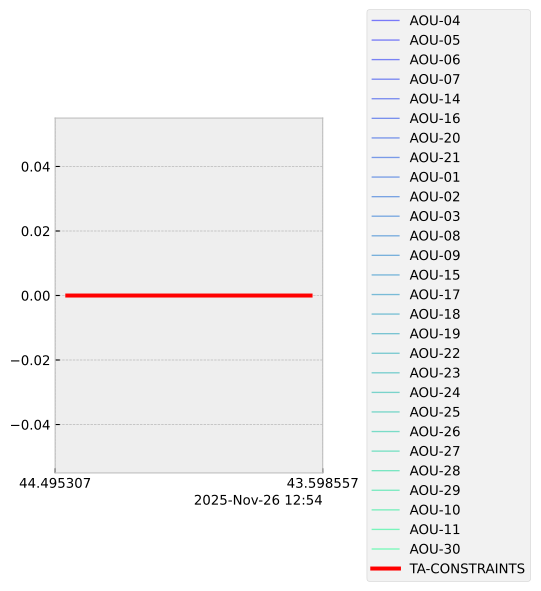
date-time |
TA-CONSTRAINTS |
AOU-04 |
AOU-05 |
AOU-06 |
AOU-07 |
AOU-14 |
AOU-16 |
AOU-20 |
AOU-21 |
AOU-01 |
AOU-02 |
AOU-03 |
AOU-08 |
AOU-09 |
AOU-15 |
AOU-17 |
AOU-18 |
AOU-19 |
AOU-22 |
AOU-23 |
AOU-24 |
AOU-25 |
AOU-26 |
AOU-27 |
AOU-28 |
AOU-29 |
AOU-10 |
AOU-11 |
AOU-30 |
|---|---|---|---|---|---|---|---|---|---|---|---|---|---|---|---|---|---|---|---|---|---|---|---|---|---|---|---|---|---|
2025-11-26 12:04:09 |
0.00 |
0.00 |
0.00 |
0.00 |
0.00 |
0.00 |
0.00 |
0.00 |
0.00 |
0.00 |
0.00 |
0.00 |
0.00 |
0.00 |
0.00 |
0.00 |
0.00 |
0.00 |
0.00 |
0.00 |
0.00 |
0.00 |
0.00 |
0.00 |
0.00 |
0.00 |
0.00 |
0.00 |
0.00 |
2025-12-10 14:14:18 |
0.00 |
0.00 |
0.00 |
0.00 |
0.00 |
0.00 |
0.00 |
0.00 |
0.00 |
0.00 |
0.00 |
0.00 |
0.00 |
0.00 |
0.00 |
0.00 |
0.00 |
0.00 |
0.00 |
0.00 |
0.00 |
0.00 |
0.00 |
0.00 |
0.00 |
0.00 |
0.00 |
0.00 |
0.00 |
2025-12-16 13:14:25 |
0.00 |
0.00 |
0.00 |
0.00 |
0.00 |
0.00 |
0.00 |
0.00 |
0.00 |
0.00 |
0.00 |
0.00 |
0.00 |
0.00 |
0.00 |
0.00 |
0.00 |
0.00 |
0.00 |
0.00 |
0.00 |
0.00 |
0.00 |
0.00 |
0.00 |
0.00 |
0.00 |
0.00 |
0.00 |
2026-01-12 14:03:00 |
0.00 |
0.00 |
0.00 |
0.00 |
0.00 |
0.00 |
0.00 |
0.00 |
0.00 |
0.00 |
0.00 |
0.00 |
0.00 |
0.00 |
0.00 |
0.00 |
0.00 |
0.00 |
0.00 |
0.00 |
0.00 |
0.00 |
0.00 |
0.00 |
0.00 |
0.00 |
0.00 |
0.00 |
0.00 |
2026-01-15 09:03:37 |
0.00 |
0.00 |
0.00 |
0.00 |
0.00 |
0.00 |
0.00 |
0.00 |
0.00 |
0.00 |
0.00 |
0.00 |
0.00 |
0.00 |
0.00 |
0.00 |
0.00 |
0.00 |
0.00 |
0.00 |
0.00 |
0.00 |
0.00 |
0.00 |
0.00 |
0.00 |
0.00 |
0.00 |
0.00 |
2026-01-15 09:53:53.821650 |
0.00 |
0.00 |
0.00 |
0.00 |
0.00 |
0.00 |
0.00 |
0.00 |
0.00 |
0.00 |
0.00 |
0.00 |
0.00 |
0.00 |
0.00 |
0.00 |
0.00 |
0.00 |
0.00 |
0.00 |
0.00 |
0.00 |
0.00 |
0.00 |
0.00 |
0.00 |
0.00 |
0.00 |
0.00 |
(Note: The guidance, evidence, confidence scoring and checklist sections below are copied from CodeThink’s documentation of TSF. However, the answers to each point in the evidence list and checklist are specific to this project.)
Guidance
Constraints on reuse, reconfiguration, modification, and deployment are specified to enhance the trustability of outputs. To ensure clarity, boundaries on what the output cannot do - especially where common domain assumptions may not hold - must be explicitly documented. These constraints are distinct from misbehaviour mitigations; instead, they define the context within which the system is designed to operate, including all modes and environmental considerations. This upfront documentation clarifies intended use, highlights known limitations, and prevents misinterpretation.
These constraints, categorised into explicit limitations and assumptions of use, guide both stakeholders and users (integrators, maintainers, operators, and end-users). They define the intended scope and provide a clear interface for how upstream and downstream systems can integrate, modify, install, reuse, or reconfigure to achieve the desired output. The documentation must also specify the contexts in which the integrity of existing Statements is preserved and whether reimplementation is required, considering device maintenance assumptions, including software updates and vulnerability mitigation.
Crucially, these limitations are not unresolved defects from triage decisions but deliberate exclusions based on design choices. Each omission should be supported by a clear rationale (linked to relevant Expectations and analyses with the appropriate architectural and abstraction levels) to ensure transparency for future scope expansion and to guide both upstream and downstream modifications.
To remain effective in practice, constraints must consider user-friendliness in relation to associated Misbehaviours (TA-MISBEHAVIOURS) and AWIs (TA-INDICATORS):
Include mechanisms to prevent misuse (e.g., protecting runtime parameters from corruption or unauthorized modification during both development and operation), explicitly linking them to relevant Misbehaviours and their analyses (as defined in TA-MISBEHAVIOURS).
Present constraint-related data with emphasis on availability, clarity, and transparent communication of defined safe states, along with the mechanisms that transition the system into those states, ensuring they are connected to the relevant AWIs (as defined in TA-INDICATORS).
Finally, the documentation must establish and promote a clear process for reporting bugs, issues, and requests.
Suggested evidence
Installation manuals with worked examples
Answer:
Configuration manuals with worked examples
Answer:
Specification documentation with a clearly defined scope
Answer:
User guides detailing limitations in interfaces designed for expandability or modularity
Answer:
Documented strategies used by external users to address constraints and work with existing Statements
Answer:
Confidence scoring
The reliability of these constraints should be assessed based on the absence of contradictions and obvious pitfalls within the defined Statements.
Checklist
Are the constraints grounded in realistic expectations, backed by real-world examples?
Answer:
Do they effectively guide downstream consumers in expanding upon existing Statements?
Answer:
Do they provide clear guidance for upstreams on reusing components with well-defined claims?
Answer:
Are any Statements explicitly designated as not reusable or adaptable?
Answer:
Are there worked examples from downstream or upstream users demonstrating these constraints in practice?
Answer:
Have there been any documented misunderstandings from users, and are these visibly resolved?
Answer:
Do external users actively keep up with updates, and are they properly notified of any changes?
Answer:
TA-DATA | Reviewed: ⨯ | Score: 0.0#
Data in eclipse-score/inc_nlohmann_json is collected from tests, and from monitoring of deployed software, according to specified objectives.
Supported Requests:
Item |
Summary |
Score |
Status |
|---|---|---|---|
Evidence is provided within eclipse-score/inc_nlohmann_json to demonstrate that the nlohmann/json library does what it is supposed to do, and does not do what it must not do. |
0.00 |
⨯ Item Reviewed |
Supporting Items:
Item |
Summary |
Score |
Status |
|---|---|---|---|
Results from automated tests for eclipse-score/inc_nlohmann_json are automatically collected from CI-generated JUnit reports into a persistent test results database together with metadata about the executed tests and workflows. |
0.00 |
⨯ Item Reviewed |
|
The storage location, retention limits, and intended use of captured test result data for eclipse-score/inc_nlohmann_json are documented so that the scope and reproducibility of the available test data can be understood. |
0.00 |
⨯ Item Reviewed |
References:
None
Fallacies:
None
Graph:
date-time |
TA-DATA |
JLS-18 |
JLS-45 |
|---|---|---|---|
2025-11-26 12:04:09 |
0.00 |
0.00 |
N/A |
2025-12-10 14:14:18 |
0.00 |
0.00 |
N/A |
2025-12-16 13:14:25 |
0.00 |
0.00 |
0.00 |
2026-01-12 14:03:00 |
0.00 |
0.00 |
0.00 |
2026-01-15 09:03:37 |
0.00 |
0.00 |
0.00 |
2026-01-15 09:53:53.821650 |
0.00 |
0.00 |
0.00 |
(Note: The guidance, evidence, confidence scoring and checklist sections below are copied from CodeThink’s documentation of TSF. However, the answers to each point in the evidence list and checklist are specific to this project.)
Guidance
This assertion is satisfied if results from all tests and monitored deployments are captured accurately, ensuring:
Sufficient precision for meaningful analysis
Enough contextual information to reproduce the setup (e.g., runner ID, software version SHA), though not necessarily the exact results
Monitored deployments run in both production and development, validating monitoring mechanisms across environments and ensuring comparable results. Collecting and retaining all data that support project claims (together with traceability to reasoning and specifications, and including both established and experimental indicators as well as test data from all environments) preserves evidence for selecting appropriate measures and enables historical analysis.
To avoid misinterpretation, all data storage mechanisms and locations are documented, together with long-term storage strategies, so analyses can be reliably reproduced. How this data is made accessible is assessed as part of TA-ITERATIONS.
Storage strategies should account for foreseeable malicious activities and privacy considerations when handling sensitive data, including how the data is managed during transit and at rest, and whether it can be accessed in plaintext or only through appropriate tools (also considered for TA-INPUTS and TA-TESTS).
Appropriate storage strategies safeguard availability across the product lifecycle, with emphasis on release-related data, and account for decommissioning, infrastructure teardown, and post-project backups.
Evidence
Time-stamped and traceable result records for each test execution, linked to associated system under test version and specification references.
Answer: Provided by JLS-18 and JLS-45.
List of monitored indicators, linked to associated specification version references.
Answer: Runtime monitoring indicators for deployed instances are not yet implemented and are expected to be defined by the integrator (see AOU-09, AOU-18 and AOU-19).
Time-stamped and traceable test-derived data for each indicator, linked to associated system under test version and indicator specifications references.
Answer: Indicator-level data is not yet collected and should be done by the integrator (see AOU-09).
List of monitored deployments, linked to associated version and configuration references.
Answer: Not available. Monitoring of deployed instances should be specified by the integrator (see AOU-09, AOU-18 and AOU-19).
Time-stamped and traceable production data for each indicator, linked to associated deployment metadata and specification references.
Answer: Not available. Should be done by the integrator (see AOU-09, AOU-18 and AOU-19).
Confidence scoring
Confidence scoring for TA-DATA quantifies the completeness of test results (including pass/fail and performance) and the availability of data from all monitored deployments.
Checklist
Is all test data stored with long-term accessibility?
Answer: No. Test results are collected into a persistent database as part of the CI workflows, which is done as a proof of concept. Due to GitHub storage constraints, the storage of this database is currently limited.
Is all monitoring data stored with long-term accessibility?
Answer: No. Dedicated monitoring data from deployed software is not collected yet. But it is expected to be implemented by the integrator (see AOU-09, AOU-18 and AOU-19).
Are extensible data models implemented?
Answer: Test-result data is stored in a SQLite database with separate tables for workflow runs and individual test results (see JLS-18). This schema can be extended with additional fields or tables if needed.
Is sensitive data handled correctly (broadcasted, stored, discarded, or anonymised) with appropriate encryption and redundancy?
Answer: This is not explicitly applicable. The captured test data does not include personal or sensitive data.
Are proper backup mechanisms in place?
Answer: No explicit project-level backup mechanism is defined for the test results database beyond GitHub’s own infrastructure.
Are storage and backup limits tested?
Answer: The
capture_test_data_memory_sensitive.pyscript enforces size limits for the persistent database and fails the workflow if they are exceeded. There is no backup mechanism.
Are all data changes traceable?
Answer: Yes, for test data. Updates to
TSF/MemoryEfficientTestResultData.dbare performed by CI workflows and committed to thesave_historical_databranch, so Git history records each change.
Are concurrent changes correctly managed and resolved?
Answer: Largely yes for test data. The ubuntu workflow uses a concurrency group that cancels in-progress runs for the same reference, so typically only one job updates the persistent database at a time and remaining conflicts would surface as failed pushes and require manual resolution.
Is data accessible only to intended parties?
Answer: Since the library is open source, there are no unintended parties.
Are any subsets of our data being published?
Answer: Yes, as a proof of concept, CI test result data is committed to the
save_historical_databranch in the SQLite databaseTSF/MemoryEfficientTestResultData.db, which is publicly accessible via this GitHub repository.
TA-FIXES | Reviewed: ✔ | Score: 0.34375#
In the nlohmann/json repository, known bugs or misbehaviours are analysed and triaged, and critical fixes or mitigations are implemented or applied.
Supported Requests:
Item |
Summary |
Score |
Status |
|---|---|---|---|
The nlohmann/json library is actively maintained, with regular updates to dependencies, and changes are verified to prevent regressions. |
0.50 |
✔ Item Reviewed |
Supporting Items:
Item |
Summary |
Score |
Status |
|---|---|---|---|
The nlohmann/json library is widely used and actively maintained; bugs and misbehaviours are tracked publicly and transparently. |
1.00 |
✔ Item Reviewed |
|
External dependencies within nlohmann/json are checked for potential security vulnerabilities with each pull request to main. Merging is blocked until all warnings are resolved. |
1.00 |
✔ Item Reviewed |
|
Outstanding bugs or misbehaviours are analyzed within eclipse-score/inc_nlohmann_json to determine whether they are relevant for S-CORE’s use cases of the nlohmann/json library. |
0.00 |
⨯ Item Reviewed |
|
Outstanding CVEs are analyzed within eclipse-score/inc_nlohmann_json to determine whether they can be dismissed, and/or are relevant for S-CORE’s use cases of the nlohmann/json library. |
0.00 |
⨯ Item Reviewed |
|
Known bugs, misbehaviours and CVEs are analyzed and either fixed or mitigated in the nlohmann/json repository. |
0.00 |
⨯ Item Reviewed |
|
Outstanding bugs and misbehaviours are triaged in the nlohmann/json repository. |
0.00 |
✔ Item Reviewed |
|
Outstanding CVEs are triaged in the nlohmann/json repository. |
0.75 |
✔ Item Reviewed |
|
Outstanding bugs or misbehaviours of nlohmann/json are fetched and saved within eclipse-score/inc_nlohmann_json. |
0.00 |
⨯ Item Reviewed |
References:
None
Fallacies:
None
Graph:
date-time |
TA-FIXES |
JLS-05 |
JLS-04 |
JLS-11 |
JLS-30 |
JLS-29 |
JLS-28 |
JLS-33 |
JLS-57 |
|---|---|---|---|---|---|---|---|---|---|
2025-11-26 12:04:09 |
0.00 |
0.00 |
0.00 |
0.00 |
0.00 |
0.00 |
0.00 |
0.00 |
N/A |
2025-12-10 14:14:18 |
0.11 |
0.00 |
0.00 |
0.00 |
0.00 |
0.00 |
0.00 |
0.75 |
N/A |
2025-12-16 13:14:25 |
0.38 |
0.88 |
1.00 |
0.00 |
0.00 |
0.00 |
0.00 |
0.75 |
N/A |
2026-01-12 14:03:00 |
0.39 |
1.00 |
1.00 |
0.00 |
0.00 |
0.00 |
0.00 |
0.75 |
N/A |
2026-01-15 09:03:37 |
0.34 |
1.00 |
1.00 |
0.00 |
0.00 |
0.00 |
0.00 |
0.75 |
0.00 |
2026-01-15 09:53:53.821650 |
0.34 |
1.00 |
1.00 |
0.00 |
0.00 |
0.00 |
0.00 |
0.75 |
0.00 |
(Note: The guidance, evidence, confidence scoring and checklist sections below are copied from CodeThink’s documentation of TSF. However, the answers to each point in the evidence list and checklist are specific to this project.)
Guidance
This assertion is satisfied to the extent that we have identified, triaged, and applied fixes or mitigations to faults in nlohmann/json, as well as to bugs and publicly disclosed vulnerabilities identified in upstream dependencies.
Confidence can be improved by assessing known faults, bugs, and vulnerabilities to establish their relevance and impact for nlohmann/json. An important aspect is documenting how issues are discovered and tracked, including identifying additional Misbehaviours (TA-MISBEHAVIOURS) that may require immediate mitigation measures (including recalls), and how such issues are communicated to users.
In principle, this analysis should include not only the code in nlohmann/json but also its dependencies (all the way down) and the tools and data used to construct the release. In practice, however, the cost/benefit of this work must be weighed against:
the volume and quality of available bug and vulnerability reports
the likelihood that our build, configuration, or use case is actually affected
The triage process must be documented, reviewed, and evidenced as sufficient and consistently followed. Documentation must make clear how prioritisation, assignment, and rejection (e.g., for duplicates) are handled, and how mitigations are tracked to completion in a timely manner appropriate to the project’s claims and the issues discovered.
Field incidents are a key source of high-priority Misbehaviours. These require additional rigour to ensure appropriate and timely responses. For every iteration and associated change, related issue resolutions must be documented with their impact (e.g., whether new Misbehaviours were found or parts of the analysis had to be redone) and linked to the specific change, ensuring visible traceability. This information must remain available to support decision traceability throughout the project’s lifetime (as considered in TA-DATA).
As part of ongoing monitoring, the rate of incoming, resolved, and rejected issues across the project and its dependencies should be tracked for trends and anomalies, to identify shifts and to detect if a source of information is lost.
Evidence
List of known bugs fixed since last release
Answer: Provided in JLS-29
List of outstanding bugs still not fixed, with triage/prioritisation based on severity/relevance/impact
Answer: Provided in JLS-28 and JLS-11
List of known vulnerabilities fixed since last release
Answer: Provided in JLS-29
List of outstanding known vulnerabilities still not fixed, with triage/prioritisation based on severity/relevance/impact
Answer: Provided in JLS-30, JLS-33 and AOU-29
List of nlohmann/json component versions, showing where a newer version exists upstream
Answer: Not relevant since nlohmann/json has no external components, as stated in JLS-34
List of component version updates since last release
Answer: Not relevant as nlohmann/json has no external components, as stated in JLS-34
List of fixes applied to developed code since last release
Answer: Provided in JLS-29
List of fixes for developed code that are outstanding, not applied yet
Answer: Provided in JLS-11
List of nlohmann/json faults outstanding (O)
Answer: Provided in JLS-11
List of nlohmann/json faults fixed since last release (F)
Answer: Provided in JLS-29
List of nlohmann/json faults mitigated since last release (M)
Answer: Provided in JLS-29
Confidence scoring
Confidence scoring for TA-FIXES can be based on
some function of [O, F, M] for nlohmann/json
number of outstanding relevant bugs from components
bug triage results, accounting for undiscovered bugs
number of outstanding known vulnerabilities
triage results of publicly disclosed vulnerabilities, accounting for undiscovered bugs and vulnerabilities
confidence that known fixes have been applied
confidence that known mitigations have been applied
previous confidence score for TA-FIXES
Each iteration, we should improve the algorithm based on measurements
Checklist
How many faults have we identified in nlohmann/json?
Answer: 58, but none are relevant for S-CORE’s use case of the library (see JLS-11).
How many unknown faults remain to be found, based on the number that have been processed so far?
Answer: It is unlikely that there are unknown faults relevant to S-CORE.
Is there any possibility that people could be motivated to manipulate the lists (e.g. bug bonus or pressure to close).
Answer: It is unlikely that people would be motivated to manipulate the lists in nlohmann/json. The nlohmann/json project has no bug bounties, and since it is open source, third party individuals suggest fixes with no pressure/incentive to manipulate unfixed issues.
How many faults may be unrecorded (or incorrectly closed, or downplayed)?
Answer: Few or none, considering the wide use of the nlohmann/json library (see JLS-05).
How do we collect lists of bugs and known vulnerabilities from components?
Answer: We pull the list from the issues reported to nlohmann/json labelled as bug and are currently open or were opened since the last release. This list is then stored using GitHub, thereby enabling a traceability of the list.
How (and how often) do we check these lists for relevant bugs and known vulnerabilities?
Answer: Whenever we generate the documentation, the list is pulled. If there is an issue previously unrecorded, then the maintainer is encouraged by the change of the trustable score to check the relevance of the issue.
How confident can we be that the lists are honestly maintained?
Answer: Very confident, since the authors of the issues in the list mainly comprise independent downstream users.
Could some participants have incentives to manipulate information?
Answer: No such incentives have been identified.
How confident are we that the lists are comprehensive?
Answer: Fairly confident, considering the wide use of the library (see JLS-05) and that downstream users are likely to report discovered bugs.
Could there be whole categories of bugs/vulnerabilities still undiscovered?
Answer: Unlikely, considering the wide use of the library (see JLS-05) and that downstream users are likely to report discovered bugs.
How effective is our triage/prioritisation?
Answer: There is no development of the json library within S-CORE, and therefore no triage/prioritisation. Any identified bugs/vulnerabilities are reported to nlohmann/json. Within nlohmann/json, no formal triage process has been identified. Nevertheless, reported bugs and vulnerabilities seem to be handled in a timely manner.
How many components have never been updated?
Answer: None, the nlohmann/json library consists of a single header file, which the only component. This component is up to date.
How confident are we that we could update them?
Answer: Within nlohmann/json, there are no external components to update. Within S-CORE, if a new version of the nlohmann/json library is released, we are very confident that we can update to that version. (See the update process in TSF/README.md)
How confident are we that outstanding fixes do not impact our Expectations?
Answer: No outstanding fixes that impact the Expectations have been identified.
How confident are we that outstanding fixes do not address Misbehaviours?
Answer: Very confident, as no Misbehaviours have been identified.
TA-INDICATORS | Reviewed: ⨯ | Score: 0.0#
In eclipse-score/inc_nlohmann_json, advanced warning indicators for misbehaviours are identified, and monitoring mechanisms are specified, verified and validated based on analysis.
Supported Requests:
Item |
Summary |
Score |
Status |
|---|---|---|---|
Documentation is provided within eclipse-score/inc_nlohmann_json, specifying what the nlohmann/json library is expected to do, and what it must not do, and how this is verified. |
0.00 |
⨯ Item Reviewed |
Supporting Items:
None
References:
None
Fallacies:
None
Graph:
date-time |
TA-INDICATORS |
|---|---|
2025-11-26 12:04:09 |
0.00 |
2025-12-10 14:14:18 |
0.00 |
2025-12-16 13:14:25 |
0.00 |
2026-01-12 14:03:00 |
0.00 |
2026-01-15 09:03:37 |
0.00 |
2026-01-15 09:53:53.821650 |
0.00 |
(Note: The guidance, evidence, confidence scoring and checklist sections below are copied from CodeThink’s documentation of TSF. However, the answers to each point in the evidence list and checklist are specific to this project.)
Not all deviations from Expected Behaviour can be associated with a specific condition. Therefore, we must have a strategy for managing deviations that arise from unknown system states, process vulnerabilities or configurations.
This is the role of Advanced Warning Indicators (AWI). These are specific metrics which correlate with deviations from Expected Behaviour and can be monitored in real time. The system should return to a defined known-good state when AWIs exceed defined tolerances.
Guidance
This assertion is met to the extent that:
We have identified indicators that are strongly correlated with observed deviations from Expected Behaviour in testing and/or production.
The system returns to a defined known-good state when AWIs exceed defined tolerances.
The mechanism for returning to the known-good state is verified.
The selection of Advance Warning Indicators is validated against the set of possible deviations from Expected behaviour.
Note, the set of possible deviations from Expected behaviour is not the same as the set of Misbehaviours identified in TA-MISBEHAVIOURS, as it includes deviations due to unknown causes.
Deviations are easily determined by negating recorded Expectations. Potential AWIs could be identified using source code analysis, risk analysis or incident reports. A set of AWIs to be used in production should be identified by monitoring candidate signals in all tests (functional, soak, stress) and measuring correlation with deviations.
Telematics, diagnostics, or manual proof testing are of little value without mitigation. As such, AWI monitoring and mitigation should be automatic, traceable back to analysis, and formally recorded to ensure information from previously unidentified misbehaviours is captured in a structured way.
The known-good state should be chosen with regard to the system’s intended consumers and/or context. Canonical examples are mechanisms like reboots, resets, relaunches and restarts. The mechanism for returning to a known-good state can be verified using fault induction tests. Incidences of AWIs triggering a return to the known-good state in either testing or production should be considered as a Misbehaviour in TA-MISBEHAVIOURS. Relying on AWIs alone is not an acceptable mitigation strategy. TA-MISBEHAVIOURS and TA-INDICATORS are treated separately for this reason.
The selection of AWIs can be validated by analysing failure data. For instance, a high number of instances of deviations with all AWIs in tolerance implies the set of AWIs is incorrect, or the tolerance is too lax.
Evidence
Risk analyses
Answer:
List of advance warning indicators
Answer:
List of Expectations for monitoring mechanisms
Answer:
List of implemented monitoring mechanisms
Answer:
List of identified misbehaviours without advance warning indicators
Answer:
List of advance warning indicators without implemented monitoring mechanisms
Answer:
Advance warning signal data as time series (see TA-DATA)
Answer:
Confidence scoring
Confidence scoring for TA-INDICATORS is based on confidence that the list of indicators is comprehensive / complete, that the indicators are useful, and that monitoring mechanisms have been implemented to collect the required data.
Checklist
How appropriate/thorough are the analyses that led to the indicators?
Answer:
How confident can we be that the list of indicators is comprehensive?
Answer:
Could there be whole categories of warning indicators still missing?
Answer:
How has the list of advance warning indicators varied over time?
Answer:
How confident are we that the indicators are leading/predictive?
Answer:
Are there misbehaviours that have no advance warning indicators?
Answer:
Can we collect data for all indicators?
Answer:
Are the monitoring mechanisms used included in our Trustable scope?
Answer:
Are there gaps or trends in the data?
Answer:
If there are gaps or trends, are they analysed and addressed?
Answer:
Is the data actually predictive/useful?
Answer:
Are indicators from code, component, tool, or data inspections taken into consideration?
Answer:
TA-INPUTS | Reviewed: ⨯ | Score: 0.31667#
All inputs to the nlohmann/json library are assessed, to identify potential risks and issues.
Supported Requests:
Item |
Summary |
Score |
Status |
|---|---|---|---|
All inputs (and attestations for claims) for the nlohmann/json library are provided with known provenance. |
0.25 |
⨯ Item Reviewed |
Supporting Items:
Item |
Summary |
Score |
Status |
|---|---|---|---|
External dependencies within nlohmann/json are checked for potential security vulnerabilities with each pull request to main. Merging is blocked until all warnings are resolved. |
1.00 |
✔ Item Reviewed |
|
The nlohmann/json library only consists of source code in the form of a single header file, and has no binary artifacts. |
0.00 |
⨯ Item Reviewed |
|
The nlohmann/json library has no external components or dependencies besides the C++ standard components. |
0.90 |
✔ Item Reviewed |
|
The nlohmann/json project transparently lists any third party tools used in building, testing and documenting the project. |
0.00 |
⨯ Item Reviewed |
|
The eclipse-score/inc_nlohmann_json project mirrors the external nlohmann/json_test_data repository, containing test data used by the unit tests in nlohmann/json, such that the test suite can be executed without internet connectivity. |
0.00 |
⨯ Item Reviewed |
|
All third party tools used in nlohmann/json for building, testing and documenting the project are assessed within eclipse-score/inc_nlohmann_json. |
0.00 |
⨯ Item Reviewed |
References:
None
Fallacies:
None
Graph:
date-time |
TA-INPUTS |
JLS-04 |
JLS-47 |
JLS-34 |
JLS-48 |
JLS-49 |
JLS-50 |
|---|---|---|---|---|---|---|---|
2025-11-26 12:04:09 |
0.00 |
0.00 |
N/A |
0.00 |
N/A |
N/A |
N/A |
2025-12-10 14:14:18 |
0.00 |
0.00 |
N/A |
0.90 |
N/A |
N/A |
N/A |
2025-12-16 13:14:25 |
0.32 |
1.00 |
0.00 |
0.90 |
0.00 |
0.00 |
0.00 |
2026-01-12 14:03:00 |
0.32 |
1.00 |
0.00 |
0.90 |
0.00 |
0.00 |
0.00 |
2026-01-15 09:03:37 |
0.32 |
1.00 |
0.00 |
0.90 |
0.00 |
0.00 |
0.00 |
2026-01-15 09:53:53.821650 |
0.32 |
1.00 |
0.00 |
0.90 |
0.00 |
0.00 |
0.00 |
(Note: The guidance, evidence, confidence scoring and checklist sections below are copied from CodeThink’s documentation of TSF. However, the answers to each point in the evidence list and checklist are specific to this project.)
Guidance
Anything that can influence the output of the nlohmann/json project is considered an input. This includes:
Software components used to implement specified features and meet defined Expectations
Software tools, and their outputs, used for design, construction and verification
Infrastructure that supports development and release processes
All inputs (components, tools, data) and their dependencies (recursively) used to build and verify nlohmann/json releases must be identified and assessed, since they are untrusted by default.
Each input should be evaluated on verifiable merits, regardless of any claims it makes (including adherence to standards or guidance). Evaluation must include the project’s defined Expectations to ensure that inputs meet requirements, and that risks are recorded and addressed appropriately.
For components, we need to consider how their misbehaviour might impact achieving project nlohmann/json’s Expectations. Sources (e.g. bug databases, advisories) for known risks should be identified, their update frequency recorded, and tests defined for detecting them. These form the inputs to TA-FIXES.
For the tools used to construct and verify nlohmann/json, we need to consider how their misbehaviour could:
Introduce unintended changes
Fail to detect Misbehaviours during testing
Produce misleading data used to design or verify the next iteration
Where any input impacts are identified, consider:
How serious their impact might be, and whether Expectations or analysis outcomes are affected (severity)
Whether they are detected by another tool, test, or manual check (detectability)
Confidence in assessing severity and detectability can be supported by analysing development history and practices of each input to evaluate upstream sources (both third-party and first-party) for maintainability and sustainability (including, for example, testability, modularity and configurability) to reduce failure impact and support safe change.
These qualities can be estimated through evidence of software engineering best practice, applied through:
Processes defining and following design, documentation and review guidelines, carried out manually (advocating simple design, reuse, structured coding constructs, and competent release management)
Appropriate use of programming languages and their features, supported by tools such as static analysis, with regular improvement of their configurations
For impacts with high severity or low detectability (or both), additional analysis should assess whether existing tests effectively detect Misbehaviours and their impacts.
As a result, for example, any binary inputs without reproducible build steps or clear development history and maintenance processes should be treated as risks and mitigated appropriately.
Evidence
List of components used to build nlohmann/json, including:
Whether content is provided as source or binary
Answer: The nlohmann/json library consists of only source code in the form of a single header file, and has no binary artifacts (see JLS-47).
Record of component assessments:
Originating project and version
Answer: The nlohmann/json library has no external components (see JLS-34).
Date of assessments and identity of assessors
Answer: The nlohmann/json library has no external components (see JLS-34).
Role of component in nlohmann/json
Answer: The nlohmann/json library has no external components (see JLS-34).
Sources of bug and risk data
Answer: The nlohmann/json library has no external components (see JLS-34).
Potential misbehaviours and risks identified and assessed
Answer: The nlohmann/json library has no external components (see JLS-34).
List of tools used to build and verify nlohmann/json
Answer: Provided in JLS-48 and JLS-49.
Record of tool assessments:
Originating project and tool version
Answer: Provided in JLS-48 and JLS-50.
Date of assessments and identity of assessors
Answer: Provided in JLS-50.
Role of the tool in nlohmann/json releases
Answer: Provided in JLS-48 and JLS-50.
Potential misbehaviours and impacts
Answer: Provided in JLS-50.
Detectability and severity of impacts
Answer: Provided in JLS-50.
Tests or measures to address identified impacts
Answer: Provided in JLS-50.
Confidence scoring
Confidence scoring for TA-INPUTS is based on the set of components and tools identified, how many of (and how often) these have been assessed for their risk and impact for nlohmann/json, and the sources of risk and issue data identified.
Checklist
Are there components that are not on the list?
Answer: No, the nlohmann/json library has no components besides the single hpp header file.
Are there assessments for all components?
Answer: The nlohmann/json library has no components besides the single hpp header file.
Has an assessment been done for the current version of the component?
Answer: The nlohmann/json library has no components besides the single hpp header file.
Have sources of bug and/or vulnerability data been identified?
Answer: The nlohmann/json library has no components besides the single hpp header file.
Have additional tests and/or Expectations been documented and linked to component assessment?
Answer: The nlohmann/json library has no components besides the single hpp header file.
Are component tests run when integrating new versions of components?
Answer: The nlohmann/json library has no components besides the single hpp header file.
Are there tools that are not on the list?
Answer: No tools have been identified which are not listed.
Are there impact assessments for all tools?
Answer: Yes, see JLS-50.
Have tools with high impact been qualified?
Answer: Yes, see JLS-50.
Were assessments or reviews done for the current tool versions?
Answer: Yes, see JLS-50.
Have additional tests and/or Expectations been documented and linked to tool assessments?
Answer: Yes, the CI-pipeline includes tests on some third party tools, see JLS-50.
Are tool tests run when integrating new versions of tools?
Answer: Yes, the tool tests are integrated into the CI-pipeline, see JLS-50.
Are tool and component tests included in release preparation?
Answer: The tool tests are integrated into the CI-pipeline, see JLS-50.
Can patches be applied, and then upstreamed for long-term maintenance?
Answer: Yes, if ever a misbehaviour is found and patched, then a pull-request to the original project repository can be opened to upstream the changes.
Do all dependencies comply with acceptable licensing terms?
Answer: Yes, the library is licensed under MIT License.
TA-ITERATIONS | Reviewed: ⨯ | Score: 0.0#
All constructed iterations of the nlohmann/json library include source code, build instructions, tests, results and attestations.
Supported Requests:
Item |
Summary |
Score |
Status |
|---|---|---|---|
Tools are provided to build the nlohmann/json library from trusted sources (also provided) with full reproducibility. |
0.00 |
⨯ Item Reviewed |
Supporting Items:
Item |
Summary |
Score |
Status |
|---|---|---|---|
Every release of the nlohmann/json library includes source code, build instructions, test code and test results summaries. |
0.00 |
⨯ Item Reviewed |
|
All library components, build dependencies, and build tools in the nlohmann/json repository are declared in build system manifests. |
0.00 |
⨯ Item Reviewed |
|
Releases of the nlohmann/json library contain a comprehensive set of attestations. |
0.00 |
⨯ Item Reviewed |
|
All source code of the nlohmann/json library is mirrored within eclipse-score/inc_nlohmann_json. |
0.00 |
⨯ Item Reviewed |
References:
None
Fallacies:
None
Graph:
date-time |
TA-ITERATIONS |
JLS-10 |
JLS-19 |
JLS-52 |
JLS-51 |
|---|---|---|---|---|---|
2025-11-26 12:04:09 |
0.00 |
0.00 |
0.00 |
N/A |
N/A |
2025-12-10 14:14:18 |
0.00 |
0.00 |
0.00 |
N/A |
N/A |
2025-12-16 13:14:25 |
0.00 |
0.00 |
0.00 |
0.00 |
0.00 |
2026-01-12 14:03:00 |
0.00 |
0.00 |
0.00 |
0.00 |
0.00 |
2026-01-15 09:03:37 |
0.00 |
0.00 |
0.00 |
0.00 |
0.00 |
2026-01-15 09:53:53.821650 |
0.00 |
0.00 |
0.00 |
0.00 |
0.00 |
(Note: The guidance, evidence, confidence scoring and checklist sections below are copied from CodeThink’s documentation of TSF. However, the answers to each point in the evidence list and checklist are specific to this project.)
Guidance
This assertion is best satisfied by checking generated documentation to confirm that:
every iteration is a working product with evidence-backed, falsifiable Statements, together with documentation of confidence in those Statements and all required Trustable Statements.
every iteration includes instructions for building and using the product
all components, dependencies, tools, and data are identified in a manifest
the manifest provides links to source code
where source code is unavailable, the supplier is identified
An iteration consists of each batch of changes accepted into the canonical version of the product. How the canonical version is managed must be documented (for TT-CHANGES) alongside the product’s Expectations.
Every iteration must be usable as a standalone product, with verification and validation completed so that a hotfix could be released at any point. Documentation generated alongside the product must include build and usage guidance together with the project’s documented Expectations and supporting Statements, enabling any maintainer or user to reverify the state of the product and associated Statements.
For each iteration, any changes must be accompanied by attestations and reasoning, explaining the tests performed and the review steps taken, together with their outcomes (e.g., results of source code inspections). Any attestations and impact assessments must be traceable to the specific changes, authors, reviewers, and the review process documentation used.
Collating and making available all appropriate data and documentation for every iteration must be automatable, so that the product’s build can be reproduced and its analysis repeated end-to-end independently (best achieved using generated documentation and configuration as code). All relevant data, including approval statuses and dates, must be stored long-term and analysed as part of TA-DATA. For complex systems, the resulting information must be presented in a user-friendly, searchable, and accessible form.
Given such transparent documentation and attestations for every iteration, it becomes possible to analyse product and development trends over time. For releases, additional documentation should summarise all changes across the iterations since the previous release.
Evidence
list of components with source
source code
Answer: Provided by JLS-10.
build instructions
Answer: Provided by JLS-10 and JLS-19.
test code
Answer: Provided by JLS-10.
test results summary
Answer: Provided by JLS-10.
attestations
Answer: Provided by JLS-52.
list of components where source code is not available
risk analysis
Answer: There are no components without source code within this project.
attestations
Answer: There are no components without source code within this project.
Confidence scoring
Confidence scoring for TA-ITERATIONS based on
number and importance of source components
number and importance of non-source components
assessment of attestations
Checklist
How much of the software is provided as binary only, expressed as a fraction of the BoM list?
Answer: 0% is provided as binary only. The entire library consists of source code in the form of a single C++ header file.
How much is binary, expressed as a fraction of the total storage footprint?
Answer: 0% is provided as binary. The entire library consists of source code in the form of a single C++ header file.
For binaries, what claims are being made and how confident are we in the people/organisations making the claims?
Answer: 0% is provided as binary. The entire library consists of source code in the form of a single C++ header file.
For third-party source code, what claims are we making, and how confident are we about these claims?
Answer: The nlohmann/json library has no external dependencies/accesses to third party source code, as stated in JLS-34.
For software developed by us, what claims are we making, and how confident are we about these claims?
Answer: There is no software developed by us, as we just use the original nlohmann/json library within eclipse_score/inc_nlohmann_json. For the code developed in nlohmann/json, all claims and confidence are provided in the statements. See e.g., all the no-json-faults (NJF) items.
TA-METHODOLOGIES | Reviewed: ⨯ | Score: 0.0#
Manual methodologies applied for the nlohmann/json library by contributors, and their results, are managed according to specified objectives.
Supported Requests:
Item |
Summary |
Score |
Status |
|---|---|---|---|
Confidence in the nlohmann/json library is achieved by measuring and analysing behaviour and evidence over time within eclipse-score/inc_nlohmann_json. |
0.00 |
⨯ Item Reviewed |
Supporting Items:
Item |
Summary |
Score |
Status |
|---|---|---|---|
For changes that affect the behaviour or public API of the nlohmann/json library, contributors manually update the library documentation and locally rebuild it for verification. |
0.00 |
⨯ Item Reviewed |
|
Updates of the eclipse-score/inc_nlohmann_json repository are carried out in accordance with the defined and documented update process in TSF/README.md. |
0.00 |
⨯ Item Reviewed |
|
The manual process for reporting vulnerabilities in the nlohmann/json library is well defined and documented in the project’s security policy and vulnerability reporting template. |
0.00 |
⨯ Item Reviewed |
|
The manual process for extending the nlohmann/json library’s test suite is well-defined and documented, such that code coverage remains at (or close to) 100% when fixes or other non-trivial changes are proposed. |
0.00 |
⨯ Item Reviewed |
|
All manual pull requests to the nlohmann/json repository that introduce non-trivial changes are expected to explain the rationale for the proposed change and to link to an existing issue, in accordance with the project’s contribution guidelines. |
0.00 |
⨯ Item Reviewed |
|
Feature requests for the nlohmann/json repository are raised in the project’s GitHub discussions and are actively reviewed and answered by the maintainer. |
0.00 |
⨯ Item Reviewed |
|
The manual process for reporting bugs in the nlohmann/json library is well defined and documented in the project’s contribution guidelines and bug report template. |
0.00 |
⨯ Item Reviewed |
References:
None
Fallacies:
None
Graph:
date-time |
TA-METHODOLOGIES |
JLS-13 |
JLS-36 |
JLS-40 |
JLS-41 |
JLS-42 |
JLS-43 |
JLS-44 |
|---|---|---|---|---|---|---|---|---|
2025-11-26 12:04:09 |
0.00 |
0.00 |
N/A |
N/A |
N/A |
N/A |
N/A |
N/A |
2025-12-10 14:14:18 |
0.00 |
0.00 |
N/A |
N/A |
N/A |
N/A |
N/A |
N/A |
2025-12-16 13:14:25 |
0.00 |
0.00 |
0.00 |
0.00 |
0.00 |
0.00 |
0.00 |
0.00 |
2026-01-12 14:03:00 |
0.00 |
0.00 |
0.00 |
0.00 |
0.00 |
0.00 |
0.00 |
0.00 |
2026-01-15 09:03:37 |
0.00 |
0.00 |
0.00 |
0.00 |
0.00 |
0.00 |
0.00 |
0.00 |
2026-01-15 09:53:53.821650 |
0.00 |
0.00 |
0.00 |
0.00 |
0.00 |
0.00 |
0.00 |
0.00 |
(Note: The guidance, evidence, confidence scoring and checklist sections below are copied from CodeThink’s documentation of TSF. However, the answers to each point in the evidence list and checklist are specific to this project.)
Guidance
To satisfy this assertion, all manual processes used in the verification of nlohmann/json must be documented, including the methodologies applied, the results for specific aspects and iterations, and evidence that these processes were reviewed against documented criteria.
Most analysis (e.g., data analysis for TA-ANALYSIS) should be automated to enable continuous feedback. However, the quality of any remaining manual processes (whether from first parties or external third parties) must be considered and how they are documented and reviewed. Considerations should be made about how manual processes may impact identifying and addressing Misbehaviours (TA-MISBEHAVIOURS).
Assignment of responsibilities for any manual work must follow a documented process that verifies competence and grants appropriate access, with automation applied where possible. Resulting assigned responsibilities must ensure organisational robustness (e.g., avoidance of conflicts of interest) together with appropriate independent verification and validation. Manual reviews involving source inspections must follow documented guidelines, with exceptions recorded and illustrated through examples. These guidelines should evolve over time and cover:
coding patterns (e.g., good patterns, anti-patterns, defensive coding)
structured design practices (e.g., control flow constraints)
complexity management (e.g., limiting feature creep)
documentation (e.g., clear, formal figures and diagrams)
feature subset restrictions (e.g., programming language subsets)
code of conduct guidelines (e.g., review etiquette, handling disagreements)
Nevertheless, specific coding rules (e.g., memory allocation, typing, concurrency) should be integrated into automatic linting and static analysis tools where appropriate.
All processes and checks must themselves be reviewed to drive continuous improvement following specified guidelines. Any resulting changes from reviews must follow change control, regardless of who initiates them or under what circumstances.
Evidence
Manual process documentation
Answer: Manual processes relevant for nlohmann/json have been identified and documented (see JLS-36, 40, 41, 42, 43 and 44).
References to methodologies applied as part of these processes
Answer: The corresponding references are given for each statement (see JLS-36, 40, 41, 42, 43 and 44).
Results of applying the processes
Answer: Results include reviewed and merged pull requests, maintained high test coverage, published security advisories and resolved issues, updated documentation on json.nlohmann.me (see JLS-36, 40, 41, 42, 43 and 44).
Criteria used to confirm that the processes were applied correctly
Answer: The criteria are given in the documentation (see JLS-36, 40, 41, 42, 43 and 44).
Review records for results
Answer: Review records are provided by GitHub pull-request reviews and comments, issue and advisory discussions, as well as release notes describing behavioural and documentation changes (see JLS-36, 40, 41, 42, 43 and 44).
Confidence scoring
Confidence scoring for TA-METHODOLOGIES is based on identifying areas of need for manual processes, assessing the clarity of proposed processes, analysing the results of their implementation, and evaluating the evidence of effectiveness in comparison to the analysed results
Checklist
Are the identified gaps documented clearly to justify using a manual process?
Answer: Manual processes are introduced where automation is not feasible and are clearly documented. While no explicit justification for each manual step is provided, the rationale is generally clear from the surrounding context.
Are the goals for each process clearly defined?
Answer: Yes. For the manual processes that were found the goals are clearly defined in the corresponding documentation. The goals include ensuring that user-facing documentation accurately reflect behavioural and API changes, correctly handling bug and vulnerability reports, and keeping the test suite at (or close to) 100% coverage for non-trivial changes.
Is the sequence of procedures documented in an unambiguous manner?
Answer: Largely yes. Where necessary, examples and templates make the expected sequence explicit.
Can improvements to the processes be suggested and implemented?
Answer: Improvements are proposed via GitHub issues or pull request.
How frequently are processes changed?
Answer: Process changes are infrequent and usually happen with a new nlohmann/json release, when a need for improvement is identified.
How are changes to manual processes communicated?
Answer: Mostly, changes are communicated through updated documentation in the repository and release notes.
Are there any exceptions to the processes?
Answer: Known exceptions include automatic dependency updates from Dependabot as well as smaller trivial changes (such as fixing typos in documentation). These are exempted from having to manually create issues and explain the rationale behind the change.
How is evidence of process adherence recorded?
Answer: Evidence in GitHub; PR histories with reviews and passing checks, issue and advisory discussions, audit trails for documentation and test updates
How is the effectiveness of the process evaluated?
Answer: Effectiveness is evaluated indirectly via stable releases, test coverage, and documentation quality.
Is ongoing training required to follow these processes?
Answer: No formal training is required, but contributors are expected to be familiar with the contribution guidelines and security policy.
TA-MISBEHAVIOURS | Reviewed: ⨯ | Score: 0.0#
Prohibited misbehaviours for the nlohmann/json library are identified, and mitigations are specified, verified and validated based on analysis.
Supported Requests:
Item |
Summary |
Score |
Status |
|---|---|---|---|
Documentation is provided within eclipse-score/inc_nlohmann_json, specifying what the nlohmann/json library is expected to do, and what it must not do, and how this is verified. |
0.00 |
⨯ Item Reviewed |
Supporting Items:
Item |
Summary |
Score |
Status |
|---|---|---|---|
Fuzz testing is used in the nlohmann/json repository to uncover edge cases and failure modes throughout development. |
0.00 |
⨯ Item Reviewed |
|
The nlohmann/json library recognizes malformed JSON and returns an exception. |
0.00 |
⨯ Item Reviewed |
|
Malicious code changes in nlohmann/json are mitigated by code reviews, adhering to the contribution guidelines and security policy specified by nlohmann/json. |
0.00 |
⨯ Item Reviewed |
|
The nlohmann/json repository uses a static code analysis tool. |
0.00 |
⨯ Item Reviewed |
References:
None
Fallacies:
None
Graph:
date-time |
TA-MISBEHAVIOURS |
JLS-02 |
JLS-24 |
JLS-25 |
JLS-31 |
|---|---|---|---|---|---|
2025-11-26 12:04:09 |
0.00 |
0.00 |
0.00 |
0.00 |
0.00 |
2025-12-10 14:14:18 |
0.00 |
0.00 |
0.00 |
0.00 |
0.00 |
2025-12-16 13:14:25 |
0.00 |
0.00 |
0.00 |
0.00 |
0.00 |
2026-01-12 14:03:00 |
0.00 |
0.00 |
0.00 |
0.00 |
0.00 |
2026-01-15 09:03:37 |
0.00 |
0.00 |
0.00 |
0.00 |
0.00 |
2026-01-15 09:53:53.821650 |
0.00 |
0.00 |
0.00 |
0.00 |
0.00 |
(Note: The guidance, evidence, confidence scoring and checklist sections below are copied from CodeThink’s documentation of TSF. However, the answers to each point in the evidence list and checklist are specific to this project.)
The goal of TA-MISBEHAVIOURS is to force engineers to think critically about their work. This means understanding and mitigating as many of the situations that cause the software to deviate from Expected Behaviours as possible. This is not limited to the contents of the final binary.
Guidance
This assertion is satisfied to the extent that we can:
Show we have identified all of the ways in which nlohmann/json could deviate from its Expected Behaviours.
Demonstrate that mitigations have been specified, verified and validated for all Misbehaviours.
Once Expected Behaviours have been identified in TA-BEHAVIOURS, there are at least four classes of Misbehaviour that can be identified:
Reachable vulnerable system states that cause deviations from Expected Behaviour. These can be identified by stress testing, failures in functional and soak testing in TA-BEHAVIOURS and reporting in TA-FIXES. Long run trends in both test and production data should also be used to identify these states.
Potentially unreachable vulnerable system states that could lead to deviations from Expected Behaviour. These can be identified using risk/hazard analysis techniques including HAZOP, FMEDA and STPA.
Vulnerabilities in the development process that could lead to deviations from Expected Behaviour. This includes those that occur as a result of misuse, negligence or malicious intent. These can be identified by incident investigation, random sampling of process artifacts and STPA of processes.
Configurations in integrating projects (including the computer or embedded system that is the final product) that could lead to deviations from Expected Behaviour.
Identified Misbehaviours must be mitigated. Mitigations include patching, re-designing components, re-designing architectures, removing components, testing, static analysis etc. They explicitly do not include the use of AWIs to return to a known-good state. These are treated specifically and in detail in TA-INDICATORS.
Mitigations could be verified by:
Specifying and repeatedly executing false negative tests to confirm that functional tests detect known classes of misbehaviour.
Specifying fault induction tests or stress tests to demonstrate that the system continues providing the Expected Behaviour after entering a vulnerable system state.
Performing statistical analysis of test data, including using statistical path coverage to demonstrate that the vulnerable system state is never reached.
Conducting fault injections in development processes to demonstrate that vulnerabilities cannot be exploited (knowingly or otherwise) to affect either output binaries or our analysis of it, whether this is by manipulating the source code, build environment, test cases or any other means.
Stress testing of assumptions of use. That is, confirming assumptions of use are actually consistent with the system and its Expected Behaviours by intentionally misinterpreting or liberally interpreting them in a test environment. For example, we could consider testing nlohmann/json on different pieces of hardware that satisfy its assumptions of use.
Remember that a Misbehaviour is anything that could lead to a deviation from Expected Behaviour. The specific technologies in and applications of nlohmann/json should always be considered in addition to the guidance above.
At the core, a faulty design is inherently difficult to mitigate. The first priority, therefore, is to ensure a fault-tolerant and fault-avoidant design that minimises fault impact and maximises fault control across all modes and states. All design considerations should be traceable to analyses at the correct abstraction level, with appropriate partitioning and scoping, which address prevalent aspects in complex systems, such as:
Spatial constraints (e.g., memory corruption)
Temporal constraints (e.g., timing violations)
Concurrency constraints (e.g., interference)
Computational constraints (e.g., precision limits)
Performance constraints (e.g., latency spikes under load)
Environmental constraints (e.g., hardware non-determinism)
Usability constraints (e.g., human interaction errors)
Finally, each new Expectation, whether a required behaviour or a misbehaviour mitigation, introduces the potential for unexpected emergent properties, highlighting the importance of simple, understandable designs that build on established and reusable solutions.
Suggested evidence
List of identified Misbehaviours
Answer:
List of Expectations for mitigations addressing identified Misbehaviours
Answer:
Risk analysis
Answer:
Test analysis, including:
False negative tests
Answer:
Exception handling tests
Answer:
Stress tests
Answer:
Soak tests
Answer:
Confidence scoring
Confidence scoring for TA-MISBEHAVIOURS is based on confidence that identification and coverage of misbehaviours by tests is complete when considered against the list of Expectations.
Checklist
How has the list of misbehaviours varied over time?
Answer:
How confident can we be that this list is comprehensive?
Answer:
How well do the misbehaviours map to the expectations?
Answer:
Could some participants have incentives to manipulate information?
Answer:
Could there be whole categories of misbehaviours still undiscovered?
Answer:
Can we identify misbehaviours that have been understood but not specified?
Answer:
Can we identify some new misbehaviours, right now?
Answer:
Is every misbehaviour represented by at least one fault induction test?
Answer:
Are fault inductions used to demonstrate that tests which usually pass can and do fail appropriately?
Answer:
Are all the fault induction results actually collected?
Answer:
Are the results evaluated?
Answer:
Do input analysis findings on verifiable tool or component claims and features identify additional misbehaviours or support existing mitigations?
Answer:
TA-RELEASES | Reviewed: ⨯ | Score: 0.0#
Construction of releases for the nlohmann/json library is fully repeatable and the results are fully reproducible, with any exceptions documented and justified.
Supported Requests:
Item |
Summary |
Score |
Status |
|---|---|---|---|
Tools are provided to build the nlohmann/json library from trusted sources (also provided) with full reproducibility. |
0.00 |
⨯ Item Reviewed |
Supporting Items:
Item |
Summary |
Score |
Status |
|---|---|---|---|
The SHA value of the nlohmann/json library in use within eclipse-score/inc_nlohmann_json coincides with the SHA value provided by Niels Lohmann for that version. |
0.00 |
⨯ Item Reviewed |
|
Every release of the nlohmann/json library shall provide configuration management for build instructions and infrastructure. |
0.00 |
⨯ Item Reviewed |
|
Every release of the nlohmann/json library includes source code, build instructions, test code and test results summaries. |
0.00 |
⨯ Item Reviewed |
|
All library components, build dependencies, and build tools in the nlohmann/json repository are declared in build system manifests. |
0.00 |
⨯ Item Reviewed |
|
The eclipse-score/inc_nlohmann_json project mirrors the external nlohmann/json_test_data repository, containing test data used by the unit tests in nlohmann/json, such that the test suite can be executed without internet connectivity. |
0.00 |
⨯ Item Reviewed |
|
Given the same version of the repository, configuration, and documented environment, the build process shall produce identical single-include header files. |
0.00 |
⨯ Item Reviewed |
References:
None
Fallacies:
None
Graph:
date-time |
TA-RELEASES |
JLS-14 |
JLS-38 |
JLS-10 |
JLS-19 |
JLS-49 |
JLS-53 |
|---|---|---|---|---|---|---|---|
2025-11-26 12:04:09 |
0.00 |
0.00 |
N/A |
0.00 |
0.00 |
N/A |
N/A |
2025-12-10 14:14:18 |
0.00 |
0.00 |
N/A |
0.00 |
0.00 |
N/A |
N/A |
2025-12-16 13:14:25 |
0.00 |
0.00 |
0.00 |
0.00 |
0.00 |
0.00 |
0.00 |
2026-01-12 14:03:00 |
0.00 |
0.00 |
0.00 |
0.00 |
0.00 |
0.00 |
0.00 |
2026-01-15 09:03:37 |
0.00 |
0.00 |
0.00 |
0.00 |
0.00 |
0.00 |
0.00 |
2026-01-15 09:53:53.821650 |
0.00 |
0.00 |
0.00 |
0.00 |
0.00 |
0.00 |
0.00 |
(Note: The guidance, evidence, confidence scoring and checklist sections below are copied from CodeThink’s documentation of TSF. However, the answers to each point in the evidence list and checklist are specific to this project.)
Guidance
This assertion is satisfied if each iteration of nlohmann/json is repeatable, with all required inputs controlled, and reproducible (covering both nlohmann/json and the construction toolchain/environment, as described in TA-TESTS).
This assertion can be most effectively satisfied in a Continuous Integration environment with mirrored projects (see TA-SUPPLY_CHAIN) and build servers without internet access. The aim is to show that all build tools, nlohmann/json components, and dependencies are built from controlled inputs, that rebuilding produces the same binary fileset, and that builds can be repeated on any suitably configured server, with server differences shown not to affect reproducibility.
For releases in particular, builds from source must be shown to produce identical outputs both with and without cache access.
Again this will not be achievable for components/tools provided in binary form, or accessed via an external service - we must consider our confidence in attestations made by/for the supply chain.
All non-reproducible elements, such as timestamps or embedded random values from build metadata, are clearly identified and considered when evaluating reproducibility.
As a result, we gain increased confidence that the toolchain behaves correctly during version upgrades: unintended changes to the project are avoided, intended fixes produce the expected effects, and the constructed output of nlohmann/json shows the correct behavioural changes, verified and validated with test results according to TT-RESULTS analysis.
Evidence
list of reproducible SHAs
Answer: JLS-14 ensures that the SHA value of the nlohmann/json library used within eclipse-score/inc_nlohmann_json coincides with the SHA value provided by Niels Lohmann (for the same version).
list of non-reproducible elements with:
explanation and justification
Answer: The only elements which are not reproducible are 8 CMake integration tests. The list of these, together with explanation and justification, is provided in TSF/docs/non_reproducible_tests.md.
details of what is not reproducible
Answer: The only elements which are not reproducible are 8 CMake integration tests. The list of these, together with explanation and justification, is provided in TSF/docs/non_reproducible_tests.md.
evidence of configuration management for build instructions and infrastructure
Answer: Provided by JLS-10 and JLS-19.
evidence of repeatable builds
Answer: Provided by JLS-53.
Confidence scoring
Calculate:
R = number of reproducible components (including sources which have no build stage) N = number of non-reproducible B = number of binaries M = number of mirrored X = number of things not mirrored
Confidence scoring for TA-RELEASES could possibly be calculated as R / (R + N + B + M / (M + X))
Checklist
How confident are we that all components are taken from within our controlled environment?
Answer: We are very confident that all components are taken from within our controlled environment, as there are currently no external components used within the nlohmann/json library (as documented in JLS-34).
How confident are we that all of the tools we are using are also under our control?
Answer: All tools used by nlohmann/json are mirrored within our controlled environment eclipse-score/inc_nlohmann_json. Therefore, these tools are under full control of the Eclipse S-Core organisation.
Are our builds repeatable on a different server, or in a different context?
Answer: Since there is no “build” of the header-only library, yes.
How sure are we that our builds don’t access the internet?
Answer: We are confident that our builds don’t access the internet, since there is no “build” of the header-only library.
How many of our components are non-reproducible?
Answer: All of our components are reproducible, since we only use a single component, the nlohmann/json library.
How confident are we that our reproducibility check is correct?
Answer: We are very confident that our reproducibility check is correct.
TA-SUPPLY_CHAIN | Reviewed: ⨯ | Score: 0.18#
All sources and tools for the nlohmann/json library are mirrored in our controlled environment.
Supported Requests:
Item |
Summary |
Score |
Status |
|---|---|---|---|
All inputs (and attestations for claims) for the nlohmann/json library are provided with known provenance. |
0.25 |
⨯ Item Reviewed |
Supporting Items:
Item |
Summary |
Score |
Status |
|---|---|---|---|
The Eclipse S-CORE organization mirrors the nlohmann/json project in a github fork. |
0.00 |
⨯ Item Reviewed |
|
The eclipse-score/inc_nlohmann_json project mirrors the external nlohmann/json_test_data repository, containing test data used by the unit tests in nlohmann/json, such that the test suite can be executed without internet connectivity. |
0.00 |
⨯ Item Reviewed |
|
All source code of the nlohmann/json library is mirrored within eclipse-score/inc_nlohmann_json. |
0.00 |
⨯ Item Reviewed |
|
The nlohmann/json library has no external components or dependencies besides the C++ standard components. |
0.90 |
✔ Item Reviewed |
|
The mirror of nlohmann/json is configured via infrastructure under direct control, and rejects history rewrites. |
0.00 |
⨯ Item Reviewed |
References:
None
Fallacies:
None
Graph:
date-time |
TA-SUPPLY_CHAIN |
JLS-23 |
JLS-49 |
JLS-51 |
JLS-34 |
JLS-66 |
|---|---|---|---|---|---|---|
2025-11-26 12:04:09 |
0.00 |
0.00 |
N/A |
N/A |
0.00 |
N/A |
2025-12-10 14:14:18 |
0.00 |
0.00 |
N/A |
N/A |
0.90 |
N/A |
2025-12-16 13:14:25 |
0.18 |
0.00 |
0.00 |
0.00 |
0.90 |
0.00 |
2026-01-12 14:03:00 |
0.18 |
0.00 |
0.00 |
0.00 |
0.90 |
0.00 |
2026-01-15 09:03:37 |
0.18 |
0.00 |
0.00 |
0.00 |
0.90 |
0.00 |
2026-01-15 09:53:53.821650 |
0.18 |
0.00 |
0.00 |
0.00 |
0.90 |
0.00 |
(Note: The guidance, evidence, confidence scoring and checklist sections below are copied from CodeThink’s documentation of TSF. However, the answers to each point in the evidence list and checklist are specific to this project.)
Guidance
This assertion is satisfied to the extent that we have traced and captured source code for nlohmann/json and all of its dependencies (including transitive dependencies, all the way down), and for all of the tools used to construct nlohmann/json from source, and have mirrored versions of these inputs under our control. Any associated data and documentation dependencies must also be considered.
‘Mirrored’ in this context means that we have a version of the upstream project that we keep up-to-date with additions and changes to the upstream project, but which is protected from changes that would delete the project, or remove parts of its history.
Clearly this is not possible for components or tools (or data) that are provided only in binary form, or accessed via online services - in these circumstances we can only assess confidence based on attestations made by the suppliers, and on our experience with the suppliers’ people and processes.
Keep in mind that even if repositories with source code for a particular component or tool are available, not all of it may be stored in Git as plaintext. A deeper analysis is required in TA-INPUTS to assess the impact of any binaries present within the repositories of the components and tools used.
Evidence
list of all nlohmann/json components including
URL of mirrored projects in controlled environment
Answer: Provided in JLS-23, JLS-49, and complemented by JLS-34.
URL of upstream projects
Answer: Provided in JLS-23 and JLS-49.
successful build of nlohmann/json from source
without access to external source projects
Answer: As a header-only library, the nlohmann/json library requires no compilation. For the build of the test suite, see JLS-49.
without access to cached data
Answer: The library and test suite build require no cached data. CMake configuration runs from scratch, generating all artifacts deterministically as shown in ubuntu.yml workflow clean builds.
update logs for mirrored projects
Answer: Updates of nlohmann/json are documented in release notes (see JLS-13). The update process of eclipse-score/inc_nlohmann_json is detailed in the “Update Concept” section of TSF/README.md.
mirrors reject history rewrites
Answer: The eclipse-score/inc_nlohmann_json main branch is set up with a branch protection rule, which disallows force pushes and requires code reviews for all changes. The branch protection rule prevents history rewrites (see JLS-66).
mirroring is configured via infrastructure under direct control
Answer: The eclipse-score/inc_nlohmann_json repository, which contains the mirrors, is configured by “Otterdog”, which is under direct control by eclipse-score maintainers (see JLS-66).
Confidence scoring
Confidence scoring for TA-SUPPLY_CHAIN is based on confidence that all inputs and dependencies are identified and mirrored, and that mirrored projects cannot be compromised.
Checklist
Could there be other components, missed from the list?
Answer: Yes. The build toolchain is not mirrored (e.g., compilers like GCC and Clang, build tools like Bazel, and CMake, etc). The potential risk of these being deleted or unavailable is however negligible and accepted.
Does the list include all toolchain components?
Answer: See answer above.
Does the toolchain include a bootstrap?
Answer: See answer above.
Could the content of a mirrored project be compromised by an upstream change?
Answer: No. Upstream changes are only introduced into the mirror through manually reviewed merge requests, and not automatically.
Are mirrored projects up to date with the upstream project?
Answer: Yes. As of 4/12/2025 both the nlohmann/json mirror and nlohmann/json_test_data mirror are up to date with the upstream projects.
Are mirrored projects based on the correct upstream?
Answer: Yes.
TA-TESTS | Reviewed: ⨯ | Score: 0.0#
All tests for the nlohmann/json library, and its build and test environments, are constructed from controlled/mirrored sources and are reproducible, with any exceptions documented.
Supported Requests:
Item |
Summary |
Score |
Status |
|---|---|---|---|
Tools are provided to build the nlohmann/json library from trusted sources (also provided) with full reproducibility. |
0.00 |
⨯ Item Reviewed |
Supporting Items:
Item |
Summary |
Score |
Status |
|---|---|---|---|
A list of tests, which is extracted from the test execution, is provided, along with a list of test environments. |
0.00 |
⨯ Item Reviewed |
|
Fuzz testing is used in the nlohmann/json repository to uncover edge cases and failure modes throughout development. |
0.00 |
⨯ Item Reviewed |
|
All tests except the ones which are excluded when using the flag “ctest -LE not_reproducible” are reproducible. |
0.00 |
⨯ Item Reviewed |
|
Any Github Actions used in the testing process are pinned to specific commit SHAs to ensure consistent action behavior across runs. |
0.00 |
⨯ Item Reviewed |
|
Github hosted runners are used as the test environment for eclipse-score/inc_nlohmann_json. |
0.00 |
⨯ Item Reviewed |
References:
None
Fallacies:
None
Graph:
date-time |
TA-TESTS |
JLS-16 |
JLS-02 |
JLS-62 |
JLS-61 |
JLS-58 |
|---|---|---|---|---|---|---|
2025-11-26 12:04:09 |
0.00 |
0.00 |
0.00 |
N/A |
N/A |
N/A |
2025-12-10 14:14:18 |
0.00 |
0.00 |
0.00 |
N/A |
N/A |
N/A |
2025-12-16 13:14:25 |
0.00 |
0.00 |
0.00 |
0.00 |
0.00 |
N/A |
2026-01-12 14:03:00 |
0.00 |
0.00 |
0.00 |
0.00 |
0.00 |
N/A |
2026-01-15 09:03:37 |
0.00 |
0.00 |
0.00 |
0.00 |
0.00 |
0.00 |
2026-01-15 09:53:53.821650 |
0.00 |
0.00 |
0.00 |
0.00 |
0.00 |
0.00 |
(Note: The guidance, evidence, confidence scoring and checklist sections below are copied from CodeThink’s documentation of TSF. However, the answers to each point in the evidence list and checklist are specific to this project.)
Guidance
This assertion is satisfied if all build and test environments and tools used to support Expectations are shown to be reproducible, all build and test steps are repeatable, and all required inputs are controlled. TA-TESTS does not include reproducibility of nlohmann/json itself, this is instead included in TA-RELEASES.
All tools and test environments should be constructed from change-managed sources (see TA-UPDATES) and mirrored sources (see TA-SUPPLY_CHAIN). Additional evidence needs to demonstrate that construction of tools and environments produces the same binary fileset used for testing and that builds can be repeated on any suitably configured server (similar to how the nlohmann/json is evaluated for TA-RELEASES).
Test environment repeatability should be ensured to enable effective Misbehaviour investigations, and enable additional data generations (including those by third parties). To achieve repeatability, all infrastructure, hardware, and configurations must be identified and documented for all test environments. Storage of this information is evaluated in TA-DATA, and its availability is considered in TA-ITERATIONS.
Evidence
Test build environment reproducibility
Answer: Provided by JLS-62.
Test build configuration
Answer: Provided by JLS-16.
Test build reproducibility
Answer: Provided by JLS-62.
Test environment configuration
Answer: Provided by JLS-16.
Confidence scoring
Confidence scoring for TA-TESTS is based on confidence that the construction and deployment of test environments, tooling and their build environments are repeatable and reproducible.
CHECKLIST
How confident are we that our test tooling and environment setups used for tests, fault inductions, and analyses are reproducible?
Answer: The test can be reproduced any time on any machine running the versions of the operating systems and compilers as provided, as described in AOU-14.
Are any exceptions identified, documented and justified?
Answer: To the best of our knowledge, there are no exceptions identified.
How confident are we that all test components are taken from within our controlled environment?
Answer: All tests are either self-contained or download test data from within Eclipse S-CORE.
How confident are we that all of the test environments we are using are also under our control?
Answer: Very confident, as the environments are standard docker images of ubuntu and standard versions of compilers that are executed in our CI pipeline.
Do we record all test environment components, including hardware and infrastructure used for exercising tests and processing input/output data?
Answer: No, since the tests are independent from hardware, there is no record of hardware or infrastructure.
How confident are we that all tests scenarios are repeatable?
Answer: All test scenarios are repeated daily in the CI pipeline.
TA-UPDATES | Reviewed: ✔ | Score: 0.65#
nlohmann/json library components, configurations and tools are updated under specified change and configuration management controls.
Supported Requests:
Item |
Summary |
Score |
Status |
|---|---|---|---|
The nlohmann/json library is actively maintained, with regular updates to dependencies, and changes are verified to prevent regressions. |
0.50 |
✔ Item Reviewed |
Supporting Items:
Item |
Summary |
Score |
Status |
|---|---|---|---|
Pull requests in the nlohmann/json repository are merged only after code review. |
0.00 |
⨯ Item Reviewed |
|
The develop branch of nlohmann/json is protected, i.e. no direct commits are possible. |
1.00 |
✔ Item Reviewed |
|
The nlohmann/json repository has well-defined community standards, including a contribution guideline and a security policy. |
1.00 |
✔ Item Reviewed |
|
All pull requests to the develop branch in the nlohmann/json repository trigger a request for review from Niels Lohmann (@nlohmann). |
1.00 |
✔ Item Reviewed |
|
Pull requests in the nlohmann/json repository are merged only after running CI-tests and successfully passing the pipeline. |
0.00 |
⨯ Item Reviewed |
|
The nlohmann/json library has no external components or dependencies besides the C++ standard components. |
0.90 |
✔ Item Reviewed |
References:
None
Fallacies:
None
Graph:
date-time |
TA-UPDATES |
JLS-06 |
JLS-07 |
JLS-12 |
JLS-32 |
JLS-35 |
JLS-34 |
|---|---|---|---|---|---|---|---|
2025-11-26 12:04:09 |
0.00 |
0.00 |
0.00 |
0.00 |
0.00 |
0.00 |
0.00 |
2025-12-10 14:14:18 |
0.38 |
0.35 |
0.00 |
0.00 |
1.00 |
0.00 |
0.90 |
2025-12-16 13:14:25 |
0.65 |
0.00 |
1.00 |
1.00 |
1.00 |
0.00 |
0.90 |
2026-01-12 14:03:00 |
0.65 |
0.00 |
1.00 |
1.00 |
1.00 |
0.00 |
0.90 |
2026-01-15 09:03:37 |
0.65 |
0.00 |
1.00 |
1.00 |
1.00 |
0.00 |
0.90 |
2026-01-15 09:53:53.821650 |
0.65 |
0.00 |
1.00 |
1.00 |
1.00 |
0.00 |
0.90 |
(Note: The guidance, evidence, confidence scoring and checklist sections below are copied from CodeThink’s documentation of TSF. However, the answers to each point in the evidence list and checklist are specific to this project.)
Guidance
This assertion requires control over all changes to nlohmann/json, including configurations, components, tools, data, documentation, and dependency versions used to build, verify, and validate it.
As part of change control, all automated checks must run and pass (e.g., tests, static analysis, lint checks) before accepting proposed changes. These checks must be configured against appropriate claims and coding guidelines. Where a change affects tracked claims, the impact must be identified, reasoned, and verified, with linked analysis performed (e.g., input analysis for new dependencies as per TA-INPUTS). Even changes with no direct impact on project claims must be justified.
Multiple roles (assigned to appropriate parties under suitable guidelines) should be involved in assessing changes. Reviews must focus on the integrity and consistency of claims, the software, and its tests. What each reviewer did or did not examine must be recorded, and this information (together with all checks) made available for every change throughout the project lifecycle (see TA-DATA). Details of manual quality management aspects are addressed in TA-METHODOLOGIES.
As a result, all changes must be regression-free (blocking problematic changes until resolved) and aim to exhibit the following properties:
simple
atomic
modular
understandable
testable
maintainable
sustainable
Practices that enforce these properties help identify and resolve inconsistent changes early in development.
Change control itself must not be subverted, whether accidentally or maliciously. Process documentation, guidance, and automated checks must also be under change control, approved by appropriate parties, and protected with suitable security controls.
To prevent regressions and reduce the rate of bugs and vulnerabilities, consistent dependency updates must be applied and new issues promptly addressed (TA-FIXES). Evidence for each iteration must demonstrate that change control requirements are applied consistently and evolve as improvements are identified, ensuring the process remains repeatable and reproducible. Timeliness must be monitored across detection, resolution, and deployment, with automation and process improvements introduced where delays are found.
Ultimately, the trustable controlled process is the only path to production for the constructed target software.
Evidence
change management process and configuration artifacts
Answer: Provided in JLS-06, JLS-07, JLS-12, JLS-32, JLS-34, JLS-35 and AOU-27.
Confidence scoring
Confidence scoring for TA-UPDATES is based on confidence that we have control over the changes that we make to nlohmann/json, including its configuration and dependencies.
Checklist
Where are the change and configuration management controls specified?
Answer: In the contribution guidelines and security policy.
Are these controls enforced for all of components, tools, data, documentation and configurations?
Answer: Yes. Any proposed change is subject to the same change controls.
Are there any ways in which these controls can be subverted, and have we mitigated them?
Answer: No. The controls are enforced using branch protection rules and are mostly automated.
Does change control capture all potential regressions?
Answer: Yes. All changes are tested in the branch ‘develop’ before being deployed to the master branch.
Is change control timely enough?
Answer: The change control is indeed timely enough. Any issues or discussions opened are addressed within a reasonable time frame.
Are all guidance and checks understandable and consistently followed?
Answer: Yes. The contribution guideline is clear and well-documented, and checks are enforced through automatic CI workflows.
TA-VALIDATION | Reviewed: ✔ | Score: 0.0#
All specified tests are executed repeatedly, under defined conditions in controlled environments, according to specified objectives.
Supported Requests:
Item |
Summary |
Score |
Status |
|---|---|---|---|
Evidence is provided within eclipse-score/inc_nlohmann_json to demonstrate that the nlohmann/json library does what it is supposed to do, and does not do what it must not do. |
0.00 |
⨯ Item Reviewed |
Supporting Items:
Item |
Summary |
Score |
Status |
|---|---|---|---|
The CI pipeline in the upstream nlohmann/json repository executes the unit and integration test suites on each pull request (opened, reopened, synchronized). |
0.00 |
⨯ Item Reviewed |
|
A scheduled GitHub workflow in eclipse-score/inc_nlohmann_json triggers the nlohmann/json unit and integration test at least once per day and records their outcomes as time-stamped entries in the persistent test results database. |
0.00 |
⨯ Item Reviewed |
References:
None
Fallacies:
None
Graph:
date-time |
TA-VALIDATION |
JLS-01 |
JLS-22 |
|---|---|---|---|
2025-11-26 12:04:09 |
0.00 |
0.00 |
0.00 |
2025-12-10 14:14:18 |
0.00 |
0.00 |
0.00 |
2025-12-16 13:14:25 |
0.00 |
0.00 |
0.00 |
2026-01-12 14:03:00 |
0.00 |
0.00 |
0.00 |
2026-01-15 09:03:37 |
0.00 |
0.00 |
0.00 |
2026-01-15 09:53:53.821650 |
0.00 |
0.00 |
0.00 |
(Note: The guidance, evidence, confidence scoring and checklist sections below are copied from CodeThink’s documentation of TSF. However, the answers to each point in the evidence list and checklist are specific to this project.)
Guidance
This assertion is satisfied when tests demonstrate that the features specified to meet project Expectations (TT-EXPECTATIONS) are present and function as intended. These tests run repeatedly in a controlled environment (TA-TESTs) on a defined schedule (e.g., daily, per change, or per candidate release of nlohmann/json).
Confidence grows when tests not only verify Expectations but also validate (continuously) that they meet stakeholder and user needs. Robust validation depends on three aspects:
TA-VALIDATION – a strategy that produces representative and stressing data.
TA-DATA – appropriate handling of collected data.
TA-ANALYSIS – analysis methods that remain dependable as the project evolves.
This structure enables iterative convergence toward required behaviours, even when early validation results are unsatisfactory.
A strategy to generate appropriate data addresses quantity, quality, and selection:
Selection: Testing remains exploratory, combining monitoring with verified and new indicators (supporting TA-INDICATORS). Coverage spans input, design, and output analysis with traceable specifications and results (considering TA-BEHAVIOURS). Tests also support calibration of capacity, scalability, response time, latency, and throughput, executed in targetted conditions and under stress (e.g., equivalence class and boundary-value testing).
Quantity: Automation scheduling provides sufficient repetition and covers diverse environments (e.g., multiple hardware platforms). Failures block merge requests, with pre- and post-merge tests giving fast feedback. Adequacy of data is assessed through TA-ANALYSIS.
Quality: Test suites include fault induction (considering TA-MISBEHAVIOURS) and checks that good data yields good results while bad data yields bad results.
Evidence
Test results from per-change tests
Answer: CI runs the tests on each change (JLS-01), and their results are stored in the persistent test results database (JLS-18, JLS-45).
Test results from scheduled tests as time series
Answer: Provided in JLS-22.
Confidence scoring
Confidence scoring for TA-VALIDATION is based on verification that we have results for all expected tests (both pass / fail and performance).
Checklist
Is the selection of tests correct?
Answer: The upstream nlohmann/json test suite plus the additional TSF-related tests cover the expected behaviours captured in the Expectations (JLEX-01, JLEX-02).
Are the tests executed enough times?
Answer: Yes, tests run on each pull request and push via the CI workflows (JLS-01) and additionally on a daily schedule in inc_nlohmann_json (JLS-22).
How confident are we that all test results are being captured?
Answer: For the CI workflows that write to the persistent test-results database we are reasonably confident, since capture is automated by the TSF scripts (JLS-18, JLS-45).
Can we look at any individual test result, and establish what it relates to?
Answer: For CI runs, yes. Each stored test result is linked to a specific CI workflow run (repo, run_id, run_attempt) and timestamp in workflow_info, so we can relate it back to the corresponding GitHub workflow execution, code revision and CI configuration (see JLS-18).
Can we trace from any test result to the expectation it relates to?
Answer: Each stored test result includes the test name (e.g.
test-unicode1), which maps to a concrete test source file. These test files are referenced in TSF statements (e.g.NPF-01.1) that are linked to their parent Expectations (e.g.NPF-01). This allows us to trace from an individual test result to the corresponding Expectation.
Can we identify precisely which environment (software and hardware) were used?
Answer: For CI runs we can identify the software environment (OS image, compiler, and configuration) via the stored metadata and
list_of_test_environments.md(JLS-17, JLS-18). The exact GitHub-hosted hardware is only roughly known and is not considered critical for this library.
How many pass/fail results would be expected, based on the scheduled tests?
Answer: All scheduled unit and integration tests are expected to pass (zero failures).
Do we have all of the expected results?
Answer: Yes, for the selected workflows we typically have results for each run, potential gaps arise when CI runs are skipped or cancelled, or due to storge limitation.
Do we have time-series data for all of those results?
Answer: Stored test results are timestamped and can be queried as a time series (JLS-18, JLS-45), but due to storage limits we only keep a truncated history rather than a complete time series over the whole project lifetime.
If there are any gaps, do we understand why?
Answer: Yes, gaps arise by design from the memory sensitive storage strategy (only initial snapshots and relevant changes are kept, see TSF/scripts/README.md and JLS-45), from the fixed size limits on the persistent database, and from the fact that we do not collect runtime monitoring data for deployed instances yet (see AOU-09, AOU-18 and AOU-19).
Are the test validation strategies credible and appropriate?
Answer: Yes, the upstream nlohmann/json test suite is extensive and is complemented by additional TSF-related tests. These tests are executed on each change and on a daily schedule via CI (JLS-01, JLS-22), and their results are stored and analysed through TA-DATA and TA-ANALYSIS.
What proportion of the implemented tests are validated?
Answer: For the CI workflows, all implemented automated unit and integration tests are executed and their results are captured in the persistent database.
Have the tests been verified using known good and bad data?
Answer: Yes, the upstream test suite of nlohmann/json uses dedicated JSON test data (including JSON parsing test suite: https://github.com/nlohmann/json_test_data/tree/master/json_tests and the big list of naughty strings in
json_test_data: https://github.com/nlohmann/json_test_data/tree/master/big-list-of-naughty-strings) and the parsers are fuzz-tested 24/7 via Google OSS-Fuzz, exercising many known-good and intentionally malformed inputs.